• Deficits and Defensiveness: Inside the School Board's $4M Bridge Loan
    15 Nov 2026

    Welcome back to Wisconsin and Whitewater Politics. Following up on our autopsy of the November 3rd referendum vote, this episode dives into the immediate fallout and the structural chaos inside the Whitewater Unified School District's budget.

    Just 24 hours after voters rejected the funding request, the school board held an emergency Zoom meeting to borrow $4 million from Premier Bank just to make late-fall payroll. We break down exactly how a district passes an 11% larger budget with a built-in $3.6 million deficit, only to find itself in a severe cash flow desert before winter property taxes arrive. We also examine the questionable optics of "mill rate management"—including $600,000 stashed away as a financial shock absorber—and the board's debate over reviewing 15 different service contracts for competitive bidding.

    As the board pivots toward a second referendum attempt in April, the gap between public perception and municipal accounting has never been wider. This episode equips Walworth, Rock, and Jefferson County voters with the financial facts needed ahead of the next regular board meeting on November 23rd.

    Episode Highlights:

    • The November 4th emergency $4 million payroll loan.
    • Understanding the statutory spending ceiling and defensive "mill rate management".
    • Why the district's expenses and property tax revenues are structurally misaligned.
    • The push for transparency and competitive bidding on service contracts.
    • Preparing for the expected second referendum attempt on April 6, 2027.

    Tags:#WhitewaterWI #WisconsinPolitics #SchoolBoard #WalworthCounty #PropertyTaxes #EducationFinance #WUSD

    Show more Show less
    20 mins
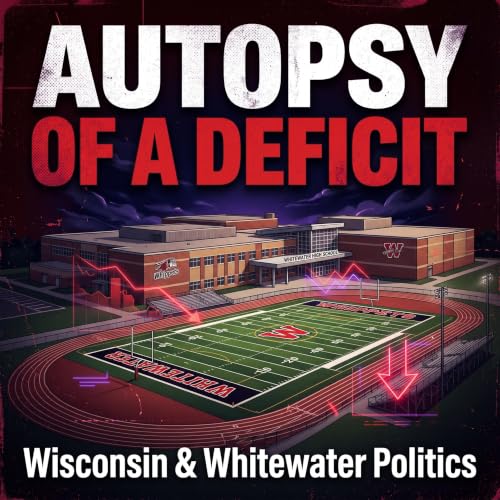
  • Autopsy of a Deficit: Why Whitewater Voters Said "No" to the School Board
    9 Nov 2026

    Following the defeat of the Whitewater Unified School District’s $5.5 million operating referendum, voters across Walworth, Rock, and Jefferson counties are asking the same question: How did the district corner itself into a projected $6.9 million fiscal cliff?

    In this deep dive, we look past talking points and political spin to examine the audited public records and state ledgers from 2018 through today. We break down the structural paradox at the heart of the district:

    • The Revenue Boom vs. Falling Enrollment: Total general fund revenues surged 45% (from $23.6M to $34.2M), even as enrollment dropped by over 160 students and operating costs ballooned to nearly $17,000 per pupil.

    • The Three-Year Rolling Average: Why the state funding formula created an illusion of permanent cash while classroom desks were quietly emptying out.

    • The Open Enrollment Drain: How more than 300 students a year leaving for neighboring districts like Elkhorn pulled over $2 million of local tax money out of Whitewater's budget.

    • The ESSER Shell Game: The mechanics behind "supplanting" federal COVID relief money—and how over $2 million in newly freed operational funds ended up paying for synthetic sports turf instead of classroom reserves.

    • Capital vs. Operating: Why the community approved a $30 million building bond in 2025, yet voted down day-to-day operating expenses in 2026.

    Whether you're a parent, a taxpayer, or a local voter watching school board governance in Southeastern Wisconsin, this episode unpacks both sides of the debate—from the district's rising special education mandates to the board's contentious spending priorities—and asks what comes next as the district braces for 2027.

    #WhitewaterWI #WUSD #SchoolBoard #WhitewaterSchools #WalworthCounty #RockCounty #JeffersonCounty #WisconsinPolitics #EducationFunding #Referendum2026

    Show more Show less
    43 mins
  • For Sale: Wisconsin Supreme Court
    4 Apr 2026

    Episode 3: Taylor vs. Lazar—The Battle for the Bench

    Is Wisconsin’s high court independent, or is it an "extreme" political prize?

    Five days before the April 7 election, Appeals Court judges Chris Taylor and Maria Lazar faced off in their only televised debate, painting each other as extreme figures unfit for the state’s highest bench. With early voting already underway and over 355,000 ballots cast, the race has reached a fever pitch.

    In this episode, we break down the final sprint of the 2026 race—a contest that could either solidify liberal control until 2030 or maintain the current 4-3 ideological split.

    • The Debate Fireworks: We analyze the heated exchanges from the April 2 debate, where Taylor attacked Lazar’s "extreme, right-wing agenda" and Lazar cast Taylor as a "radical, extreme legislator."

    • Fundraising Dominance: Taylor continues her massive financial lead, raising over $6.18 million to Lazar’s $1.21 million. New reports show Taylor outspent Lazar by more than 6-to-1 in the final weeks, flooding the airwaves with TV and online ads.

    • The Abortion Battleground: Hear the candidates' clashing views on the 1849 abortion law. Taylor criticized Lazar for calling the Dobbs decision "very wise," while Lazar accused Taylor of supporting "abortion up until the moment of birth."

    • Redistricting & Election Integrity: Why this race is critical for the future of Wisconsin's congressional maps and the 2028 presidential election. While both declined to comment on pending litigation, Taylor positioned herself as a "pro-democracy" candidate against election interference.

    • Polling the Undecideds: A late March Marquette Law School Poll found 46% of likely voters still undecided. We look at why Republicans are slower to align with a candidate than their Democratic counterparts.

    A Taylor victory would expand the liberal majority to 5-2, providing a buffer that could protect liberal rulings on labor rights, environmental regulations, and voting access for years to come. Lazar warns her supporters that the liberal majority must not be allowed to grow, arguing the court needs "balance" to reflect the people of Wisconsin.

    The 2026 Power Struggle:The Stakes for Wisconsin:

    Show more Show less
    45 mins
  • The Billionaire’s Gavel: Are Wisconsin’s Judges for Sale?
    1 Apr 2026

    Think the law is a fixed rulebook? Think again. As the November 7 election approaches, Wisconsin finds itself at the center of a high-stakes tug-of-war where the "spirit of the law" is being used to bypass the will of the voters.

    This deep dive exposes the mechanical reality of the Wisconsin Supreme Court race between Judge Maria Lazar and Chris Taylor. Why are out-of-state billionaires pouring 15 times more cash into one side of this fight? It’s not a donation—it’s a transaction. We’re unpacking the "systemic bribe" of judicial flexibility and how "Superhero Judges" use vague philosophies to rewrite the rules from the bench, effectively silencing the legislature and the people of Wisconsin.

    Before you head to the polls, find out if you're voting for a referee who follows the rulebook or a politician in a black robe who makes it up as they go.

    • Textualism vs. Purposivism: The clash between sticking to the written word (Lazar) and interpreting the "purpose" of the law (Taylor).

    • The "Myth of the Judicial Superhero": Why a judge "saving the day" is actually a direct threat to a functioning democracy.

    • Follow the Money: An analysis of the massive funding disparity and why billionaires prefer a "flexible" bench over a strict one.

    • Historical Warning Signs: Lessons from Lochner v. New York and Roe v. Wade on what happens when judges act as "super-legislators."

    • The Wisconsin Lockdown Saga: How the text of the law forced a conservative judge to rule against his own political base.

    Make an informed choice for Whitewater and all of Wisconsin this November.

    Key Discussion Points

    Show more Show less
    44 mins
  • Inside the Wisconsin Supreme Court Race: Two Judges, Two Philosophies, Massive Stakes
    30 Mar 2026

    In this deep-dive podcast, we take a close, balanced look at one of the most important — and most under-the-radar — elections happening right now: the April 7, 2026 Wisconsin Supreme Court race between Appeals Court Judges Maria Lazar and Chris Taylor.

    On the surface, it’s a nonpartisan race for a single 10-year seat. In reality, the outcome could lock in (or prevent) a 5-2 liberal majority on the court for years to come. One vote on this bench will shape critical issues affecting every Wisconsinite: redistricting and voting rights, abortion access, environmental regulations like PFAS, eminent domain and property rights, emergency powers, labor law, and more — in a battleground state that often decides national elections.

    We break down:

    • The sharp differences in their judicial philosophies: strict textualism and judicial restraint (Lazar) versus a rights-focused, protective approach (Taylor).
    • Their actual appellate records, including key cases on PFAS regulations, informed consent, parental rights, voter records, and criminal procedure.
    • The massive fundraising gap: Taylor’s side has outspent Lazar’s by more than 15-to-1, fueled heavily by out-of-state progressive donors including a top New York music industry executive and a powerful New York philanthropist.
    • What this money really means for judicial independence and future rulings.

    Whether you care about property rights, worker protections, government overreach, clean water, or fair elections, this race will have real consequences for Wisconsin families for the next decade. No hype, no spin — just a clear, in-depth analysis of the candidates, the cases that define them, and why this “quiet” election matters far more than most people realize.

    New episode dropping soon. Hit follow and turn on notifications so you don’t miss it.

    #WisconsinSupremeCourt #LazarVsTaylor #WisconsinPolitics

    Show more Show less
    49 mins
  • The 2026 Wisconsin Lieutenant Governor Race
    30 Mar 2026

    a detailed deep dive into the 2026 Lieutenant Governor race.

    Show more Show less
    33 mins