We Can Work It Out omslagsbild

We Can Work It Out

We Can Work It Out

Av: Dr Jonathan Lord
Lyssna kostnadsfritt nu, utan abonnemang

Das größte Angebot der Saison | 0,99 € pro Monat für die ersten 3 Monate + 15 € Audible-Guthaben

Danach 6,99 €/Monat. Bedingungen gelten. Monatlich kündbar.
Om den här titeln

Hello and welcome to We Can Work It Out — the podcast that explores the history, present and future of workers’ rights.

I’m your host, Dr Jonathan Lord: in each episode we’ll be delving into the stories, struggles and successes that have shaped working lives. From friendly societies to people management- we welcome academics, activist’s, trade unionist’s, policymakers and workers themselves to help us understand what fair work really means in a changing world.

2026 Dr Jonathan Lord
Management & Leadership Welt Ökonomie
Avsnitt
  • Episode 24 - Rethinking HRM, Employment Relations & Employee Outcomes
    Nov 16 2026

    Do HR best practices really work, or have we been asking the wrong questions about how to improve working lives?

    In this episode of the We Can Work It Out podcast, Dr Jonathan Lord is joined by Professor Paul Edwards, Emeritus Professor of Employment Relations at the University of Birmingham and a leading scholar in industrial relations and the sociology of work.

    Drawing on his provocative paper, Time to Change the Conversation on Employment Relations Practices and Outcomes for Employees: 11 Theses, Paul challenges conventional thinking about HRM, employee engagement and organisational performance.

    We explore whether HR practices genuinely benefit employees, why increased engagement can sometimes mean greater work intensity, and how management, workplace conflict, trade unions and employee voice shape working lives.

    Paul also reflects on his extensive workplace research and why understanding organisational context is more important than searching for universal management solutions.

    What if the secret to better workplaces isn't finding the perfect HR practice, but understanding what actually happens between employers and employees?

    An insightful conversation for anyone interested in HRM, employment relations, management and the future of work. Enjoy the discussion.

    Visa mer Visa mindre
    46 min
  • Episode 23 - Invisible Work, Unequal Rights: Domestic Workers, Migration and Human Rights
    Nov 8 2026

    In this episode of 'We Can Work It Out,' Dr. Jonathan Lord interviews Dr. Natalie Sadaka, an expert in employment law focusing on domestic and migrant workers.

    They discuss the historical devaluation of domestic work, the intersection of gender and race in labor dynamics, and the challenges faced by domestic workers in terms of legal protections and enforcement.

    Dr. Sadaka highlights the complexities of labor law as it applies to domestic settings, the impact of immigration status on workers' rights, and the ongoing issues of exploitation and forced labor. The conversation also touches on the cultural acceptance of domestic work and the significant enforcement gap that leaves many workers vulnerable. This conversation explores the challenges faced by domestic workers, particularly regarding their rights, immigration status, and the emotional toll of separation from family. It discusses the barriers to claiming rights through employment tribunals, the harsh realities of family reunification policies, and the intersection of gender and race in domestic work.

    The conversation also highlights the undervaluation of domestic work and the need for better protections and recognition of labor rights as human rights.

    You can purchase Natalie's book using this link and applying the code, AUFLY30, for a 30% discount. Enjoy the discussion.


    Visa mer Visa mindre
    1 tim och 8 min
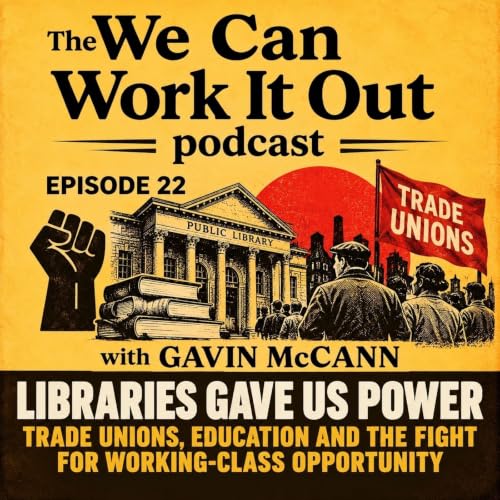
  • Episode 22 - Libraries Gave Us Power: TU, Education & the Fight for Working-Class Opportunity
    Nov 2 2026

    In this episode of 'We Can Work It Out', Dr. Jonathan Lord speaks with Gavin McCann, a seasoned trade unionist and author, about the historical and ongoing significance of education within the trade union movement.

    They explore themes such as the role of autodidacts, the fear of educating the working class, and the impact of the 1870 Education Act. Through personal stories and historical examples, they highlight how education has been a powerful tool for empowerment and social change in the labor movement. This conversation explores the historical development of the Labour Party and its connections to trade unions, education, and political representation.

    It highlights the importance of figures like Will Thorne and Tom Mann in shaping the Labour movement, the establishment of educational institutions like Ruskin College and the Central Labour College, and the impact of the Pleb Strike on workers' education. The discussion emphasizes the need for a strong connection between trade unions and the Labour Party to ensure representation for the working class.

    This conversation explores the evolution of trade union education, highlighting its professionalization post-World War II, the marginalization of women in trade union history, and the barriers to education faced by workers. It discusses successful union learning programs, particularly the Ford Employee Development Assistance Programme, and emphasizes the importance of education in the labor movement.

    The dialogue concludes with reflections on lessons for today's labor movement and the need for unions to focus on education and community support.

    Enjoy the discussion

    Visa mer Visa mindre
    1 tim och 38 min
adbl_web_anon_alc_button_suppression_t1
Inga recensioner ännu