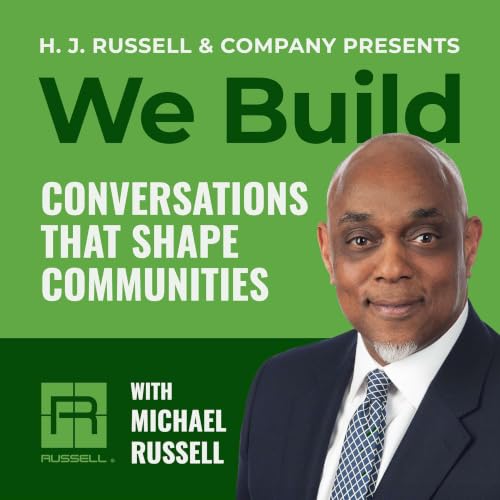
We Build with Michael Russell okładka

We Build with Michael Russell

We Build with Michael Russell

Autor: H. J. Russell & Company
Słuchaj bezpłatnie, bez subskrypcji

Das größte Angebot der Saison | 0,99 € pro Monat für die ersten 3 Monate + 15 € Audible-Guthaben

Danach 6,99 €/Monat. Bedingungen gelten. Monatlich kündbar.
O tym tytule

We Build with Michael Russell is a podcast about leadership, legacy, and the real work of shaping cities and communities.​

Hosted by H.J. Russell & Company CEO Michael Russell, the series features candid conversations with industry leaders, community stewards, and trusted partners who are building what matters most—strong organizations, enduring places, and communities built to thrive.

With more than 70 years of experience across construction management, program management, and development, H.J. Russell & Company brings a unique perspective shaped by execution at scale. Episodes explore how major projects actually get done—from navigating complexity and managing risk to aligning people, capital, and vision across sectors such as aviation, higher education, sports, affordable housing, and mission-critical facilities.​

We Build goes beyond project highlights. It examines how leaders think, how decisions get made, and how long-term value is created through disciplined execution, trusted partnerships, and a commitment to doing the work the right way.​

Designed for C-suite executives, developers, and public-sector leaders, We Build offers practical insight into what it takes to lead, deliver, and build with purpose in today’s evolving built environment.​

Because building isn’t just about structures—it’s about the people, partnerships, and decisions that shape what comes next.

© 2026 We Build with Michael Russell
Literatura i reportaże podróżnicze Nauki społeczne
  • Modernizing airports without grounding operations: a conversation with HJ Russell & Company’s Curtis Wilson
    Oct 27 2026
    Airport construction operates under a rule that does not apply almost anywhere else in the built environment: the site can never fully close. Curtis Wilson, Vice President of Transportation and Infrastructure at H.J. Russell & Company, joins host Michael Russell to explain what it takes to modernize some of the country’s busiest airports while flights continue to take off, bags keep moving, and passengers make their way through active terminals. With more than 30 years of experience on major aviation programs including Hartsfield-Jackson Atlanta International Airport, DFW, and LAX, Curtis shares how aging infrastructure, increasing passenger demand, and interconnected projects are changing the way airport capital programs are managed.Airports operate more like small cities than traditional construction sites, with airport owners, airlines, TSA, concessionaires, contractors, and passengers all affected by the work. Curtis explains why successful programs require coordination at the program level, early involvement from operations, security, and maintenance teams, clear governance for decision-making, and careful phasing and sequencing. At Hartsfield-Jackson, that philosophy comes down to a simple principle: operations first, construction second. Program management becomes the connective tissue that keeps scope, cost, schedule, risk, operations, and stakeholder commitments aligned.Modular construction offers a clear example of what that approach can accomplish. Curtis shares how using modular construction for the Concourse D widening at Hartsfield-Jackson reduced the traditional construction timeline by 48 months while allowing the concourse to remain active. He also explains why modular construction needs to influence the design from the beginning and why owners should start with the business case rather than the latest construction trend. Looking ahead, Curtis discusses the growing pressure from aging infrastructure, passenger growth, workforce and supply chain challenges, and technologies such as digital twins and predictive maintenance that will increasingly shape how airports operate and maintain their assets.Key TakeawaysAirports need an estimated $175 billion in infrastructure investment over the next five years to keep pace with aging systems and rising passenger volumes.An airport functions like a small city, and successful capital programs require aligning airport owners, airlines, TSA, concessionaires, and passengers around one coordinated plan.Program-level coordination, not isolated project management, is what keeps interconnected airport projects from working against each other.Modular construction reduced the Concourse D widening timeline at Hartsfield-Jackson by 48 months, without shutting the concourse down.Modular construction works best when it shapes the design from the start, not when it is applied after a project has already been designed traditionally.Clear governance, defining how decisions get made and escalated, is one of the most important tools for keeping a program moving efficiently.The strongest programs operate on a simple principle: operations first, construction second.Connect with Curtis Wilson, Vice President - Transportation & Infrastructure, H.J. Russell & Companyhttps://www.linkedin.com/in/curtis-m-wilson-pmp-396a541b/Curtis Wilson is a nationally recognized leader in transportation and infrastructure with over 34 years of experience delivering multi-billion-dollar capital programs across the aviation, water, transit, and municipal sectors. As Vice President at H.J. Russell & Company, Curtis has directed more than 20B), the Hartsfield-Jackson Atlanta International Airport Capital Program (4.2B), the Los Angeles World Airports Capital Program (15B),andMoreMARTAAtlanta(6B).Curtis brings deep expertise in standing up and operating high-performing Project Management Offices (PMOs), program governance frameworks, and fully integrated project controls. His technical command spans CPM scheduling, earned value management, risk analysis, and enterprise program management information systems (PMIS).A certified Project Management Professional (PMP), Curtis is also a dedicated mentor and team builder, known for cultivating high-performance teams that thrive in complex, fast-paced environments. He is a longtime member of the Project Management Institute (PMI) and the Association for the Advancement of Cost Engineering (AACE), and remains committed to driving innovation in capital project delivery nationwide.Connect with Michael Russell, CEO, H.J. Russell & Company: https://www.linkedin.com/in/michaelrussellsr/ https://www.hjrussell.com/ Rate, Review, & Follow on Apple Podcasts:We hope you’re finding value in our podcast, We Build. Your feedback is important to us, and we’d love to hear from you. Here’s how you can help. Scroll to the bottom, rate our podcast with five stars, and select “Write a Review.” Let us know what you found most helpful from this ...
    Rozwiń Zwiń
    27 min
  • It Takes a Team: Leonard Adams on Delivering Affordable Housing in Atlanta
    Sep 25 2026

    Affordable housing development in Atlanta requires collaboration across developers, public agencies, funders, designers, contractors, and community organizations, and this conversation between Michael Russell, CEO of H.J. Russell & Company, and Leonard Adams, founder and CEO of Quest Community Development Corporation, explores exactly how that collaboration comes together. The Atlanta Regional Commission estimates that Metro Atlanta will need roughly 367,000 additional homes in the years ahead to keep pace with growth. Leonard traces his path into community development back to his family’s entrepreneurial roots in Detroit and his mother’s employment agency in Atlanta, an experience that first exposed him to housing instability among workers and ultimately led him to found Quest Community Development Corporation in 2001.

    Affordable housing funding in Atlanta increasingly depends on blending government dollars, corporate impact investment, and philanthropy, a strategy Leonard credits with helping nonprofit developers like Quest keep rents affordable while still meeting rising development costs. He also discusses how supportive housing, pairing affordable units with services like ID assistance and benefits navigation, helps residents stay housed long term, and why assembling the right team for the right scale of project matters more than chasing the biggest name available. Leonard reflects on Quest’s partnership with H.J. Russell & Company on developments including Residences at Grove Park, Heritage Village, Simpson West, and Avon City, part of the Westside Housing Trifecta, a 115 million dollar closing of three projects within weeks of each other.

    Atlanta’s affordable housing progress also depends on early, honest engagement with neighborhoods and city planning offices, and Leonard explains why understanding the city’s community planning process is essential for any developer hoping to build there successfully. The conversation closes with Leonard’s outlook on the city’s progress toward Mayor Andre Dickens’ goal of 20,000 to 25,000 affordable housing units, Quest’s upcoming 25th anniversary, and the advice he would give any developer assembling a team for their first affordable housing project in Atlanta.

    Key Takeaways

    • Affordable housing works best as a collaborative effort involving developers, funders, government agencies, contractors, and community organizations from the earliest planning stages.
    • Blending public funding, corporate impact investment, and philanthropy helps nonprofit developers keep rents affordable despite rising development costs.
    • Choosing the right size and type of general contractor for each project keeps budgets and timelines aligned.
    • Early and transparent engagement with city planning offices and neighborhood planning units builds trust and helps developments move through Atlanta’s approval process smoothly.
    • Atlanta’s affordable housing goals call for 20,000 to 25,000 new units and continued collaboration among funders and developers will be needed to meet ongoing demand.


    Connect with Leonard Adams, Founder and CEO, Quest Community Development Corporation

    https://www.questcdc.org/leonard-adams


    Leonard Adams is the founder and CEO of Quest Community Development Corporation, an Atlanta-based nonprofit focused on affordable housing, supportive services and community development.

    Since founding Quest in 2001, Adams has helped expand the organization’s work across affordable and supportive housing and community development, with a significant focus on Atlanta’s Westside.

    He brings more than two decades of experience working with public, private, and nonprofit partners to advance housing and community development opportunities in Atlanta.


    Connect with Michael Russell, CEO, H. J. Russell & Company:

    https://www.linkedin.com/in/michaelrussellsr/

    https://www.hjrussell.com/

    Rate, Review, & Follow on Apple Podcasts:

    We hope you’re finding value in our podcast, We Build. Your feedback is important to us, and we’d love to hear from you.

    Here’s how you can help. Scroll to the bottom, rate our podcast with five stars, and select “Write a Review.” Let us know what you found most helpful from this episode!

    And if you haven’t done so already, give the podcast a follow, and you'll be notified when new episodes come out.


    Rozwiń Zwiń
    37 min
  • How Legacy, Leadership, and Purpose Drive Success in the Built Environment with Michael Russell
    Jun 3 2026

    Legacy, leadership, and purpose in the built environment. These are the foundations upon which HJ Russell and Company has operated for more than 70 years, and they are the driving force behind the launch of the We Build podcast.

    We Build is a podcast for leaders in the AEC industry who understand that construction is more than what rises on a skyline. It is about vision, access, accountability, and what gets left behind. Expect conversations with developers, designers, public officials, and entrepreneurs who are shaping the future of cities and the profession itself.

    Rozwiń Zwiń
    6 min
adbl_web_anon_alc_button_suppression_t1
Brak recenzji