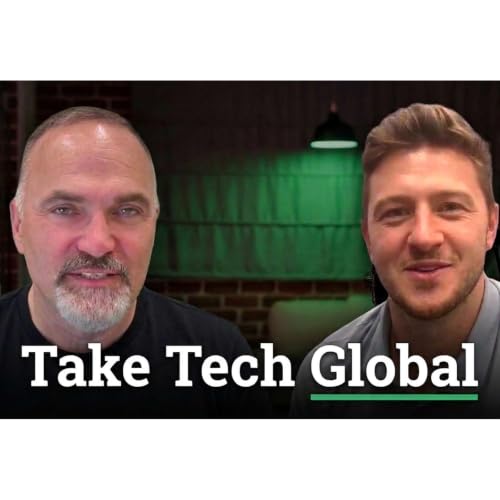
• The One Question Every Tech Seller Should Ask About International Tech deals, conversation with Anthony Rousseau with TecEx.
    Nov 6 2026
    Send us Fan MailInternational Tech Deals, Customs Risk, and the Hidden Costs of Global Hardware MovesChris Whitaker sits down with Anthony Rousseau, Chief Revenue Officer at TecEx, to unpack the overlooked side of international technology projects: import compliance, customs risk, taxes, and who carries the liability when hardware crosses borders. The conversation starts with Anthony’s unconventional path from bankruptcy law into commercial leadership, then explores how TecEx helps buyers and sellers get technology deployed globally without getting stuck in customs.They discuss why AI infrastructure is driving new international logistics demand, why lawyers can make strong commercial operators, and how technology advisors can ask better questions about taxes, duties, and DDP responsibility before a deal gets painful.Key topicsAnthony’s career path was not linear: He started in bankruptcy law, joined an Office of the CEO program, and moved through product development and sales before becoming CRO at TecEx.Law turned out to be a sales skillset in disguise: Attorneys sell trust, judgment, and risk management. Those skills—and knowing when to speak—carry directly into commercial work.Human communication still matters in an AI-heavy world: Anthony argues that computers are still weak at reading what a client means but does not say. Emotional intelligence, nuance, and judgment remain valuable differentiators.Networking and events require a strategy: Chris shares why one strong introduction can justify the cost of attending a conference. Anthony adds that effective events require planning and the right people in the room.TecEx fills a gap in international technology deployment: The company provides Importer of Record services when a buyer or seller cannot take on import responsibility themselves.TecEx handles compliance and coordinates logistics: Rather than operating its own fleet, TecEx partners with logistics providers and focuses on legal, regulatory, and customs requirements. Anthony uses India’s BIS, DGFT, and SCOMET requirements as an example.International deals carry margin risk: TecEx provides an end-to-end cost and takes responsibility for certain cost changes and customs issues, helping customers reduce risk.Tariffs, duties, and VAT can change the economics of a deal: Anthony explains the differences and why these costs should be considered before equipment reaches customs.AI is driving demand for global hardware deployment: TecEx works with hyperscalers and neocloud providers moving GPU compute internationally. The team also uses AI for research, qualification, and sales development.The strongest customer relationships are often long-term: TecEx supports both resellers, as an extension of their supply chain, and end users, as an extension of their trade compliance and operations teams.Two questions can uncover hidden risk: “Have you thought about the taxes?” and “Who is responsible for them?”Timestamps00:00 - Introducing TecEx and the hidden complexity of international tech deals 01:59 - Anthony’s legal background and path into commercial leadership 04:17 - Why attorneys can be strong salespeople 06:05 - Why communication and reading people matter in the AI era 08:16 - Conferences, networking, and event ROI 11:19 - Booth design, swag, and making the most of tech events 12:29 - Are conferences for business development or brand building? 14:12 - Anthony’s interest in technology and AI 16:59 - AI, LLMs, and the terminology around “super intelligence” 17:49 - Why ChatGPT became Anthony’s default thinking partner 19:27 - Why you should challenge AI instead of letting it simply agree 20:45 - What TecEx does beyond moving hardware across borders 23:30 - India import compliance: BIS, DGFT, and SCOMET 25:40 - TecEx’s role in legal, administrative, and logistics coordination 26:53 - Stuck shipments, customs delays, and DDP risk 29:38 - Tariffs, duties, VAT, and protecting deal margins 32:16 - How AI has affected TecEx’s market and internal workflows 35:22 - Why “AI factories” may better describe modern data centers 36:34 - TecEx’s two main customer profiles: resellers and end users 39:23 - The two questions to ask about international taxes 40:36 - Adrian Gore’s leadership lesson on urgency and time 42:54 - Final thoughts and how to reach TecExMore on TecExMore on Anthony Rousseau Support the showCheck out my website https://thewirelessway.net/ use the contact button to send request and feedback.
    Visa mer Visa mindre
    43 min
  • Wavelengths #4- Whit and Waverly hit on whats going on in tech today.
    Nov 9 2026

    Send us Fan Mail

    In this Wavelinks episode, we explore how satellite, cellular, fiber and cloud networking are converging—and why resilient connectivity is becoming a business strategy, not just a carrier choice.


    We discuss combining fiber, 5G, satellite and SD-WAN to keep critical operations connected, from air ambulance crews to construction sites and retailers. The key question for technology advisors: what breaks when connectivity fails, and how long can your customer afford the silence?


    A practical conversation about building continuity around customer needs, not just selling a circuit.

    Support the show

    Check out my website https://thewirelessway.net/ use the contact button to send request and feedback.

    Visa mer Visa mindre
    7 min
  • Whit and Waverly Wavelinks: The future of connectivity, AI in the network, and a practical AI prompt for work #3
    Oct 26 2026

    Send us Fan Mail

    Whit and Waverly Wavelinks: The future of connectivity, AI in the network, and a practical AI prompt for work

    This episode is a solo-hosted tech commentary from Chris, framed as a back-and-forth between Wit and Waverly. It covers three major wireless industry developments and why they matter for advisors, especially as satellite, cellular, fiber, and fixed wireless continue to converge.The episode also closes with a practical AI prompt anyone can use to turn a messy workload into an organized action plan.

    Key topics

    • In this episode, Chris opens with the launch of Whit and Waverly Wavelinks, a recurring series focused on the intersection of human experience and artificial intelligence.
    • The first headline is SpaceX reportedly seeking access to at least 80,000 cell sites across the US, signaling that satellite connectivity still needs terrestrial infrastructure.
    • The second headline is T-Mobile, Nokia, and Nvidia’s first AI-RAN phone call on a live commercial network, showing AI moving deeper into the network itself.
    • The third headline is AT&T adding about 769,000 net new fiber and fixed wireless internet connections, reinforcing that customers care more about reliable connected experience than whether it is wired or wireless.
    • Chris argues that many advisors are still selling on bandwidth and price, while the market is shifting toward outcomes, uptime, and business continuity.
    • The discussion frames connectivity as increasingly intelligent, data-heavy, latency-sensitive, and security-sensitive, which changes how value should be sold and measured.
    • A Star Trek style comparison leads into the idea that the future is not satellite versus cellular, but both working together.
    • The episode lands on a clear sales takeaway: stop selling pipes, start selling uptime.
    • Chris shares an AI productivity prompt designed to help users organize a chaotic workload into do today, schedule for later, delegate, or drop.
    • The closing message emphasizes that while technology keeps changing, the goal remains the same: help people and businesses stay connected.

    Timestamps

    00:00 - Introducing Whit and Waverly Wavelinks and the show’s mission
    01:06 - SpaceX eyes 80,000 cell sites and the satellite plus terrestrial future
    01:34 - AT&T’s fiber and fixed wireless growth points to convergence
    02:02 - Are advisors keeping up with network change?
    02:28 - Connectivity is becoming more intelligent, data-driven, and security-sensitive
    04:12 - Why the future is both satellite and cellular, not one or the other
    04:39 - Customers care whether it works and fits the budget, not the technology label
    05:35 - The gas station example: downtime becomes lost revenue in real time
    06:33 - Selling uptime instead of pipes, speed, or coverage
    07:01 - Asking for one practical AI prompt listeners can use today
    07:53 - AI prompt: turn a messy brain dump into priorities and next steps
    08:19 - Wavelinks AI tip of the week and show close
    09:01 - Final wrap: stay connected, stay curious, keep doing business the wireless way

    Key frameworks

    • Outcome-based selling - Start with what the customer is trying to achieve, not the connectivity medium.
    • Uptime economics - Translate outages into lost revenue, not just technical inconvenience.
    • AI chief of staff prompt - Use AI to sort chaos into immediate actions, future tasks, delegation, and elimination.

    Notable quotes

    • “Stop selling pipes, start selling uptime.”
    • “You don’t need to be organized to use AI. You can use AI to get organized.”
    • “The future isn’t satellite or cellular, it’s both.”

    Support the show

    Check out my website https://thewirelessway.net/ use the contact button to send request and feedback.
    Visa mer Visa mindre
    10 min
  • WHIT & WAVERLY WAVELENGTHS, Two minds. Different wiring. One frequency. #2
    Oct 24 2026

    Send us Fan Mail

    SpaceX, AI, and the future of connectivity all collide in this fast-moving episode of The Wireless Way. If you want to know what a reported SpaceX push for access to tens of thousands of U.S. cell towers could mean for coverage, competition, and your phone bill, this is the conversation to hear.Chris Whitaker is joined by Waverly, his AI co-host, to unpack the real-world implications behind the headlines - from whether satellite-backed networks could close dead zones to why better coverage may matter more than lower prices when carriers start competing harder. The discussion keeps it practical, with a sharp focus on what’s confirmed, what’s still speculation, and why rollout timelines in telecom are rarely quick.You’ll also hear a useful AI playbook for business professionals who want more than generic prompts. Waverly shares a simple but powerful shift: stop treating ChatGPT like a search engine and start using it like a thinking partner. That means better prep before meetings, smarter follow-up after them, and stronger decision-making in between.We break down:

    • Why the SpaceX tower story matters even before any official rollout

    • How competition could reshape pricing, plans, and coverage

    • A practical framework for using AI before and after customer meetings

    • Why the biggest AI advantage is not speed, but better thinking

    • The risk of using AI without judgment, context, or data protection

    Chris brings 25+ years of tech perspective, while Waverly adds the AI lens, challenge, and tactical guidance that helps listeners separate hype from actual business value. Together, they make the case that AI should amplify your experience, not replace it.Essential listening if you care about wireless trends, emerging tech, or using AI more effectively at work - without falling for the noise.

    Support the show

    Check out my website https://thewirelessway.net/ use the contact button to send request and feedback.

    Visa mer Visa mindre
    7 min
  • From Math to Gaming: Joe Cassavaugh's Story
    Oct 28 2026

    Send us Fan Mail

    In this episode of The Wireless Way, host Chris Whitaker interviews Joe Cassavaugh , a successful software engineer and entrepreneur known for his popular clutter puzzle game franchise. Joe shares his journey from a pure mathematics background to the world of software engineering and gaming. He discusses the evolution of gaming technology, his entrepreneurial insights, and the psychology behind why people enjoy playing games. Joe emphasizes the importance of creativity, persistence, and understanding player needs in achieving business success. In this conversation, Joseph Cassavaugh shares his journey in game development, highlighting the significant impact of transitioning to Unity on his productivity and success. He discusses the role of AI in the industry, expressing skepticism about its effectiveness and emphasizing the importance of human creativity. Looking ahead, Joseph reflects on the future of his Clutter games and the evolving landscape of the gaming industry, as he prepares for a semi-retirement while continuing to innovate in game design.

    Joe Cassavaugh's journey showcases the intersection of creativity and technology.
    His background in mathematics played a crucial role in his software engineering career.
    The evolution of gaming technology has significantly impacted game development.
    Joe's clutter puzzle games have created a new genre in casual gaming.
    Persistence and adaptability are key traits for entrepreneurs.
    Understanding player psychology is essential for game design.
    Joe emphasizes the importance of feedback in refining game mechanics.
    He believes anyone can find success by identifying gaps in the market.
    The clutter franchise continues to thrive due to its brand awareness.
    Joe's approach to game development focuses on player experience and flexibility. It took me 10 years to make my first million.
    Unity significantly improved my game development process.
    AI is not as special as people think.
    Garbage in, garbage out applies to AI.
    Clutter games have become their own genre.
    I'm shifting to smaller games as I approach retirement.
    The game industry is facing significant challenges.
    Human creativity will always be valuable in game design.
    My games aim to provide a positive experience, not just time-wasting.
    Engagement with players is crucial for game success.


    00:00 "I created a game that made zero money."

    30:15 "I like proving people wrong."

    30:51 "I give more bang for the buck."

    31:03 "It was experiments worth doing."

    33:33 "Unity is as big of a difference as Unix."

    36:12 "I hate AI."

    38:54 "AI is just synthesizing a bunch of crap."

    40:07 "Garbage in, garbage out."

    47:45 "Clutter's considered its own genre."

    49:40 "The game business has imploded."

    57:12 "Play the game."

    Chapters

    00:00 Introduction to Joe Casaval and His Journey

    06:24 From Mathematics to Software Engineering

    12:07 The Evolution of Gaming and Clutter Franchise

    23:22 Business Insights and Entrepreneurial Lessons

    29:36 Understanding Player Psychology in Gaming

    31:21 The Journey to Success in Game Development

    32:10 Transitioning to Unity: A Game Changer

    36:02 The Role of AI in Game Development

    46:00 Looking Ahead: Future of Clutter Games


    Check out his website-

    Joe's LinkedIn

    Keywords
    technology, gaming, entrepreneurship, software engineering, puzzle games, business success, player psychology, creativity, innovation, Clutter franchise game development, Unity, AI, technology, puzzles, Clutter games, software engineering, game design, indie games, future of gaming

    Support the show

    Check out my website https://thewirelessway.net/ use the contact button to send request and feedback.

    Visa mer Visa mindre
    50 min
  • I Interviewed AI. Then Things Got Interesting. A Chat with ChatGPT, see what I did there?
    Oct 14 2026

    Send us Fan Mail

    The Wireless Way: Human Wisdom vs AI, Empathy, Privacy, and the Future of Work

    Chris hosts a solo conversational episode with ChatGPT as the virtual co-host, using a back-and-forth format to explore the tensions between human judgment and artificial intelligence. The discussion moves through empathy, decision-making, education design, privacy, automation, AI anxiety, and regulation, with practical takeaways for leaders, sellers, and educators.In this episode, Chris and ChatGPT examine where AI is useful as a thinking partner and where human accountability still matters most. The conversation closes with a simple principle: use AI for acceleration, but keep humans in charge of direction.

    Key topics

    • Chris frames the episode as a live comparison of human wisdom versus artificial intelligence, asking whether more information actually leads to better decisions.
    • ChatGPT argues that algorithms are strong at scanning large datasets and spotting patterns, but that context, values, and lived experience are what define a good decision.
    • The episode emphasizes that AI can mimic empathy in language, but it does not feel stakes, loss, or responsibility the way people do.
    • Chris uses the session to shape an education series, and ChatGPT recommends using AI as a sparring partner by providing audience, outcome, and constraint before generating an outline.
    • They discuss how technology can connect people across distance while also reducing presence, with the key test being whether a digital interaction leaves you more connected or more drained.
    • A major theme is consequence: human advisors live with the outcomes of their advice, while AI does not, which changes the meaning of accountability.
    • On cloud intelligence versus edge intelligence, the conversation lands on a hybrid model where cloud handles heavy training and coordination while edge supports real-time response, privacy, and cost efficiency.
    • Privacy concerns are contrasted between cloud and edge, with the recommendation to minimize data, process locally when possible, and send only what is necessary.
    • On automation and employment, the episode argues that AI usually shifts tasks rather than eliminating entire jobs, while increasing the importance of judgment, relationships, and accountability.
    • Chris raises AI anxiety and the pressure to do more with saved time, prompting a reminder that productivity gains should not always be converted into more work.
    • The final policy-focused section compares innovation and regulation, arguing for pace with purpose: move fast where risk is low and slow down where stakes are high.
    • The closing takeaway is a memorable one: speed wins demos, trust wins deployments.

    Timestamps

    00:00 - Opening the experiment: a human-hosted conversation with AI
    00:24 - Can algorithms outperform human wisdom?
    00:52 - Why data alone does not guarantee better decisions
    01:37 - AI and the limits of empathy and compassion
    02:05 - AI informs, humans decide
    02:34 - Using AI as a thinking partner for an education series
    03:04 - Building a lean 30-minute session with exercises and debriefs
    04:03 - Does technology bring people together or thin out relationships?
    05:15 - Intelligence versus consequence in advice-giving
    06:14 - Turning AI output into structured input and human choice
    06:40 - A simple two-step framework for presenting options
    06:54 - Cloud intelligence versus edge intelligence
    07:41 - Privacy tradeoffs in cloud and edge systems
    08:11 - Automation, jobs, and where human value shifts
    09:39 - AI anxiety and the pressure to do more with saved time
    10:17 - Redefining productivity so AI supports better work, not just more work
    11:16 - Why some AI uses should be avoided entirely
    11:47 - Innovation versus regulation and the case for pace with purpose
    12:14 - Speed wins demos, trust wins deployments
    13:02 - The question that should always stay in the room: should we automate?
    13:30 - Closing thanks to the virtual co-host
    13:57 - Episode sign-off and final outro

    Notable quotes

    "AI informs, humans decide."

    "Speed wins demos. Trust wins deployments."

    "Don't just ask can we automate this. Also ask should we?"


    Support the show

    Check out my website https://thewirelessway.net/ use the contact button to send request and feedback.

    Visa mer Visa mindre
    18 min
  • How to Turn Existing Properties Into Bulk Internet Winners
    Sep 23 2026

    Send us Fan Mail

    Bulk Internet, MDUs, and the Business Case for Connected Communities


    Chris Whitaker talks with Braydon Manley, head of revenue at Conservice Connectivity Solutions, about bulk internet in multi dwelling units, where it makes business sense, and how technology advisors can uncover new revenue opportunities. They also dig into resident support, the conversion from retail internet to bulk setups, and why the resident experience matters more than ever.

    Key topics
    In this episode: Chris introduces the MDU connectivity space and frames bulk internet as a revenue opportunity for technologists and tech advisors.
    Braydon Manley shares his background, from music and startup work in Utah to becoming interested in connected communities and bulk internet.
    Braydon describes learning the MDU business from the ground up and why the space feels both established and constantly evolving.

    Chris and Braydon compare endurance sports to business, including Braydon’s first Boulder 70.3 triathlon and the lesson that success comes from adapting when the plan changes.
    In this episode: Conservice Connectivity Solutions sits between providers, property owners, site teams, and residents to help convert retail internet setups into bulk internet programs.

    Braydon explains why many owners underestimate the complexity of converting existing properties and why successful launches depend on resident enrollment, support, and clear benefit to the resident.

    The difference between retail and bulk internet is clarified: retail means residents set up and pay their own service, while bulk is included in rent or as an amenity.
    In this episode: bulk internet makes the most sense when it creates value for both sides - revenue and operational simplicity for owners, and better pricing, convenience, and hands off service for residents.

    Chris and Braydon discuss resident support ownership, and Braydon says their team handles tier one issues directly when they service a property.
    Technology advisors are encouraged to ask a simple but powerful question: what is your technology strategy across the portfolio?
    Market trends discussed include slower new development, flat rents, stronger demand for revenue streams, and a growing focus on retail to bulk conversions done the right way.

    Braydon notes that senior living communities and Airbnb style condo ownership can both be strong fits when the connectivity experience needs to be reliable and easy.

    Timestamps
    00:00 - Why MDU connectivity is a revenue opportunity

    01:11 - Braydon Manley’s path from music and startups to bulk internet

    05:07 - Training for Boulder 70.3 and learning to adapt when the plan changes

    11:09 - The decision to keep going in the swim instead of quitting

    13:08 - Where Conservice Connectivity Solutions fits in the MDU ecosystem

    16:34 - When bulk internet makes business sense for owners and residents

    19:28 - Who owns the problem when a resident cannot get online

    21:25 - How residents are told who to contact for support

    23:47 - Questions technology advisors should ask property owners

    26:23 - New development slowdown and the rise of retail to bulk conversions

    33:21 - What properties are not a good fit, and why affordable housing needs care

    35:54 - Senior living communities and why they can be a strong fit

    38:20 - Airbnb and vacation condo properties as emerging opportunities

    40:00 - Why this industry is relationship driven and worth getting into

    41:34 - Braydon’s running shoe picks and a quick Lightning Round

    42:46 - Closing thoughts and invitation to continue the conversation

    More on Braydon

    More on Conservice Connectivity Solutions


    Support the show

    Check out my website https://thewirelessway.net/ use the contact button to send request and feedback.

    Visa mer Visa mindre
    44 min
  • The Channel Trust Problem Nobody Talks About - And How to Fix It, Rogers Clawson with Momentum
    Aug 28 2026

    Send us Fan Mail

    Rogers Clawson on telecom channels, trust, and building beyond connectivity

    Chris Whitaker sits down with Rogers Clawson, who has worked both the agent and supplier sides of the telecom and technology channel, to unpack how the industry works when it’s done well. Rogers also shares why joining Momentum made sense, how managed services and custom network builds are reshaping opportunities, and why the best advisors focus on outcomes instead of products.

    In this episode:

    Rogers traces his path from an RCN call center to business services, Cisco certs, network engineering work, and enterprise account management.

    He shares how an early mentor at Global Communication Networks taught him the agent side of the channel and how that shaped his career.

    Rogers talks about his military background, including the National Guard, Army service, field artillery, and later time on a sniper team in Afghanistan.

    Chris and Rogers compare lessons from military service, especially accountability and the mindset of “embrace the suck” when problems hit.

    They break down the biggest misunderstanding between vendors and trusted advisors: vendors often want direct access, while TAs live on relationships and trust.

    Rogers explains why every deal is different and why a rinse and repeat SOP approach rarely works across customers, technologies, or sales motions.

    He shares how his long relationship with Metro Optical, later acquired by Momentum, led to a full-time role after years of already operating like an internal team member.

    Rogers highlights Momentum’s growth into a strong fit for multi-site, rural, international, cloud connectivity, and data center work.

    They discuss the shift from selling circuits to selling managed services, security, redundancy, and business outcomes.

    Rogers weighs in on AI’s impact on connectivity, especially in data center buildouts, high-capacity transport, and the need for fast, redundant fiber paths.


    Timestamps:

    00:00 - Chris introduces Rogers Clawson and his telecom channel background
    04:36 - Why college was not the path and how telecom work started
    05:31 - From billing support to cable modem troubleshooting and business services
    06:32 - Cisco certs, networking school, and moving into enterprise
    07:26 - Military background and service in the Army National Guard
    09:20 - Accountability and the lesson that “I don’t know” is never the final answer
    12:30 - Supplier side versus TA side and where misunderstandings start
    13:04 - Why vendors and advisors often misread each other’s motives
    14:35 - Every deal is different and why SOPs can fail in the channel
    16:53 - What made Momentum the right move after years of working together
    17:53 - How custom solutions and back-office support created trust
    20:17 - Momentum’s sales-driven culture and why that matters
    21:33 - The opportunity for TAs to expand into managed services
    23:09 - Why outcomes matter more than products or commission
    24:31 - Understanding customer business before recommending technology
    25:13 - Baker mindset versus chef mindset in solution design
    26:36 - Don’t overcomplicate simple deals
    27:55 - How AI companies are driving network and colo demand
    28:44 - Why AI data centers care more about capacity than carrier count
    30:16 - Bandwidth needs are rising, but physical builds matter more than shortages
    31:31 - Momentum’s sweet spot: aggregation, international, and cloud connectivity
    32:45 - Why hard-to-reach sites and international assets are a major advantage
    33:43 - Owning local loops and tagging agents to long-term assets
    35:46 - The ideal agent profile and how Momentum supports both simple and complex deals
    36:46 - Rogers’ favorite work: custom solutions and strategy support
    37:22 - Final advice: do your homework, build profiles, and use AI as a tool
    38:22 - Why AI still requires human judgment and explanation

    Support the show

    Check out my website https://thewirelessway.net/ use the contact button to send request and feedback.

    Visa mer Visa mindre
    40 min