The Consistency Club - Members Only Podcast Titelbild

The Consistency Club - Members Only Podcast

The Consistency Club - Members Only Podcast

Von: Adam Barski
Jetzt kostenlos hören, ohne Abo

The Consistency Club Podcast is a members-only podcast hosted by Adam Barski, focused on helping everyday people improve their running, fitness and health in a realistic and sustainable way. Each episode covers topics around running, nutrition, mindset and consistency, with a big focus on keeping things simple, enjoyable and achievable long term. Expect honest conversations, relatable stories, practical advice, client experiences and plenty of reassurance for anyone who feels like they’re struggling, overthinking or constantly starting again. This isn’t a podcast for elite athletes or people chasing perfection. It’s for normal people trying to become fitter, healthier, happier and more confident through running and better habits. Whether your goal is weight loss, improving mental health, building confidence, completing your first 5K or training for a race, this podcast is here to help you stay motivated, consistent and heading in the right direction.© 2026 Adam Barski Hygiene & gesundes Leben Laufen & Joggen
  • Slow Down to Speed Up: Why Your Easy Runs Should Actually Feel Easy
    Aug 26 2026

    Ever been given an easy run… only to finish it absolutely knackered because you couldn’t resist trying to beat last week’s pace? 😂

    You’re definitely not alone.

    In this week’s Consistency Club Guided Run, Adam explains why one of the best things you can do to become a faster, fitter and more resilient runner is surprisingly simple:

    Slow down.

    We look at why not every run needs to be a test, what easy running is actually doing inside your body, and why finishing a session feeling like you could have done more can be a sign that you’ve got it exactly right.

    In this episode:

    🏃 Why easy running matters – How slower running helps build the aerobic foundations that eventually allow you to run faster.

    🏠 Stop testing and start training – Why trying to beat your previous pace on every run is like attempting your one-rep max every time you go to the gym.

    ❤️ What happens inside your body – A simple explanation of mitochondria, capillaries, cardiovascular adaptations and why easy running helps develop your aerobic engine.

    80️⃣ The 80/20 principle – Why successful endurance training generally involves considerably more easy running than hard running — without becoming obsessed with the exact percentages.

    🗣️ How easy should “easy” actually feel? – Why the conversation test and perceived effort can sometimes be more useful than obsessing over your pace.

    🚶 Why walking isn’t cheating – How strategic run/walk intervals can help newer runners build fitness and spend longer moving without unnecessarily exhausting themselves.

    Heart rate & Zone 2 – Why heart-rate data can be useful, but you don’t need to panic because Garmin says you’ve drifted a few beats into Zone 3.

    🐢 “Running slower feels harder!” – Why deliberately slowing down can initially feel awkward and why that’s completely normal.

    💥 Hard sessions still matter – Intervals, tempo runs, track sessions, parkrun and races absolutely have their place. The key is not making every run one of them.

    💰 Your weekly energy budget – Why every hard session has a cost and how constantly overspending can eventually leave you in “fatigue debt.”

    📱 The Strava trap – Why training to impress the people looking at your activity can be completely different from training to improve the person wearing the trainers.

    🧠 Learning patience – Why the individual easy runs that don’t feel particularly impressive can become some of the most important sessions when you stack enough of them together.

    The biggest message

    Training isn’t about proving how fit you are today. It’s about creating a body that’s fitter tomorrow.

    Some sessions are there to test you.

    Some are there to push you.

    But a huge amount of your running is simply there to quietly build the foundations.

    So if today’s plan says easy 5K, you don’t need a PB.

    Slow down.

    Relax.

    Forget what the pace looks like on Strava.

    And if you finish thinking…

    “I could’ve done more.”

    Good.

    You probably got it right.

    Key takeaway:

    “Stop testing your fitness and start training it. We’re not trying to win Tuesday — we’re trying to build a runner who can keep improving for years.” 👊🏃


    Mehr anzeigen Weniger anzeigen
    22 Min.
  • What Do All Those Numbers on Your Running Watch Actually Mean?
    Aug 19 2026

    VO₂ max. HRV. Resting heart rate. Training readiness. Body Battery. Heart-rate zones. Recovery time…

    Your smartwatch gives you an incredible amount of information — but what does any of it actually mean? And more importantly, which numbers should you genuinely care about?

    In this week’s Consistency Club Guided Run, Adam breaks down the most common running-watch metrics in plain English, using simple stories and analogies to explain what your watch is actually trying to tell you.

    No sports-science degree required 😂

    In this episode:

    VO₂ Max – What it actually measures, why a bigger aerobic engine can help your running, and why your watch’s number is still only an estimate.

    ❤️ HRV (Heart Rate Variability) – Probably the most confusing number on your watch, explained simply. Why more variability can actually be a good thing and why you should compare HRV against your own baseline, not somebody else’s.

    💓 Resting Heart Rate – How endurance training can make your heart more efficient and why a sudden change from your normal resting HR can sometimes be useful information.

    🏃 Heart-Rate Zones – What Zones 1–5 mean, why Zone 2 gets so much attention, and why you shouldn’t panic every time your watch tells you you’ve drifted into Zone 3.

    🔋 Body Battery & Training Readiness – How watches combine different information to estimate recovery — and why your watch still doesn’t know everything happening in your life.

    😴 Sleep Scores – Why sleep absolutely matters, but obsessing over whether you scored 68 or 82 probably doesn’t help.

    😰 Stress – How your watch can detect signs of physiological stress and why things like hard training, poor sleep, illness, travel and alcohol can affect your numbers.

    🎒 Training Load & Recovery – Why training is like gradually adding weight to a backpack: enough stress creates adaptation, but too much without recovery eventually becomes a problem.

    👟 Cadence – What steps per minute actually means and why 180 isn’t a magical number every runner needs to chase.

    ⏱️ Pace – Why the same pace can represent completely different efforts depending on hills, heat, wind and fatigue.

    🔥 Calories Burned – Why the number on your watch is an estimate rather than permission to spend exactly 687 calories in Greggs 😂

    The biggest lesson

    Your smartwatch can be an absolutely brilliant training tool — but individual numbers rarely tell the whole story.

    Rather than panicking because your VO₂ max dropped by one point or your HRV was lower this morning, look for patterns and trends.

    Combine the numbers with the most important piece of information your watch doesn’t fully understand:

    How you actually feel.

    Your watch should help you understand your body — not make you frightened to trust it.

    Key takeaway:

    “Your watch is the dashboard. You’re the driver. Use the data to help make decisions, but don’t hand an algorithm the keys.” ⌚🏃👊


    Mehr anzeigen Weniger anzeigen
    25 Min.
  • What Should I Eat Before a Run? (Guided Run Episode 6)
    Aug 14 2026

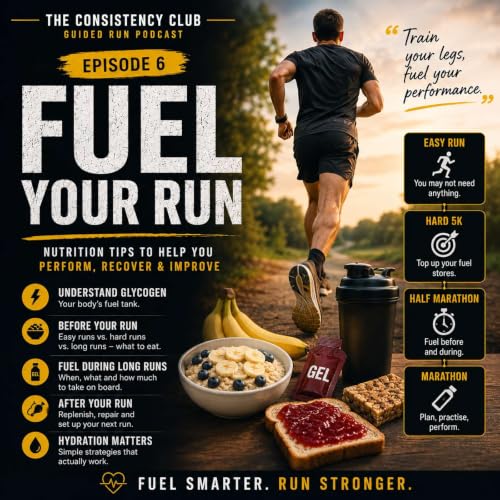
    Episode 6 – Fuel Your Run: What to Eat Before, During & After Running

    What should you eat before a run? Do you actually need breakfast before an easy 5K? When should you start using gels? And how should your fuelling change when you go from a short run to a half marathon?

    In this week’s Consistency Club Guided Run, Adam breaks down running nutrition without making it unnecessarily complicated.

    Using simple analogies and relatable examples, we look at how your body stores and uses carbohydrate, what glycogen actually is, and why the duration and intensity of your run should influence how you fuel it.

    In this episode:

    🏃 Why an easy 5K and an all-out 5K require different approaches

    ⛽ Glycogen explained as your body’s fuel tank

    🍌 Whether you actually need to eat before an easy morning run

    ⚡ What to eat before a hard 5K or parkrun attempt

    🥣 How to approach breakfast before a half marathon

    🍬 When gels and mid-run carbohydrates become useful

    ⏱️ Why runners going longer than around an hour may benefit from taking carbohydrate during their run

    🚽 Why you should NEVER experiment with new gels or food on race day 😂

    🏁 How to practise your race-day nutrition during training

    🥔 Why carbohydrate after harder and longer runs helps replenish glycogen

    🥩 The importance of protein for recovery and adaptation

    💧 Hydration, electrolytes and how hot weather changes your requirements

    🧠 Why runners trying to lose weight shouldn’t become frightened of fuelling their training

    The biggest message from this episode is that there isn’t one perfect running diet.

    An easy 30-minute run doesn’t need to be fuelled like a half marathon, and a hard 5K places very different demands on your body than a gentle 5K.

    Learn what you’re asking your body to do, practise your nutrition in training, and gradually build your own running instruction manual.

    Key takeaway:

    “Train your legs. Train your gut. Fuel the work you’re asking your body to do — and don’t wait until the fuel light comes on before looking for a petrol station.”


    Mehr anzeigen Weniger anzeigen
    21 Min.
adbl_web_anon_alc_button_suppression_t1
Noch keine Rezensionen vorhanden