Sleep Matters Podcast okładka

Sleep Matters Podcast

Sleep Matters Podcast

Autor: Dr. Erin Elliott and Jason Tierney
Słuchaj bezpłatnie, bez subskrypcji

Das größte Angebot der Saison | 0,99 € pro Monat für die ersten 3 Monate + 15 € Audible-Guthaben

Danach 6,99 €/Monat. Bedingungen gelten. Monatlich kündbar.
O tym tytule
Sleep Matters is a mocktail of snarky honesty and straight talk in dental sleep medicine you’ve been looking for. We jump on the grenades most professionals avoid, from medical and dental turf wars and insurance headaches to calling out the latest industry “snake oil.” Sit down with movers, shakers, and iconoclasts as we dive into the clinical and political issues that keep dentists up at night. You’ll learn. You’ll laugh. And you’ll actually look forward to the next episode. SLEEP MATTERS©Sleep Matters Podcast Ekonomia Higiena i zdrowy tryb życia
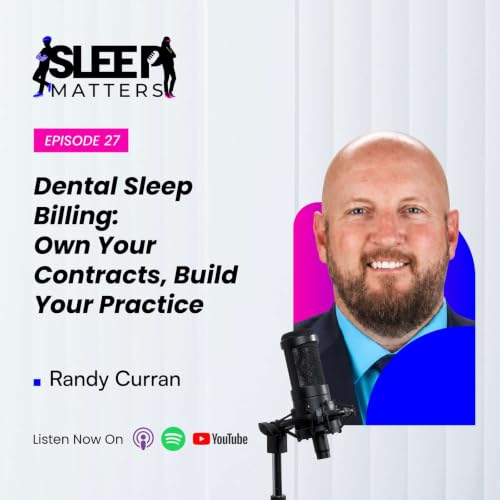
  • Dental Sleep Billing: Own Your Contracts, Build Your Practice
    Nov 25 2026

    Medical billing in dental sleep medicine is not a one-size-fits-all game. What works for a practice in Michigan may be completely wrong for a practice in Alabama, and Randy Curran has spent more than a decade watching those differences shape which practices grow and which ones struggle.

    Randy, founder and CEO of Pristine Medical Billing, joins Jason Tierney and Dr. Erin Elliott to break down how the insurance landscape has changed since he entered dental sleep medicine in 2011. The days of relying heavily on GAP approvals and large out-of-network reimbursements have shifted as carriers have built networks, established allowables, and become much more involved in controlling costs.

    They also dig into a decision that can have long-term consequences for a sleep practice: using another company's medical contracts instead of building your own. Randy explains why the "easy button" may work in the short term but can leave a dentist without control, equity, or a stable insurance foundation if that program disappears.

    For Randy, billing success also depends heavily on what happens inside the practice. Teams need enough time to manage the process, understand authorizations, communicate with patients, and follow each case carefully. Even experienced billing teams make mistakes, which is exactly why systems, communication, and accountability matter.

    The bigger lesson is that insurance should support the sleep program rather than control it. Understand your market, choose contracts strategically, build something the practice actually owns, and make the financial side as simple as possible for the patient.

    What's on the Menu

    • Why dental sleep billing strategy changes from market to market
    • How insurance networks have changed over the last 15 years
    • The risks of building a practice around someone else's contracts
    • Why your own contracts create long-term practice equity
    • The billing mistakes Randy sees newer sleep practices make
    • Why team time and buy-in matter as much as insurance strategy
    • Making the patient financial conversation simpler and more predictable

    A Few Threads You'll Hear

    There is no universal insurance strategy. Randy explains why dentists need to understand the carriers, allowables, and network dynamics in their own market instead of copying the financial strategy of a practice in another state.

    Build something you actually own. Using someone else's medical contracts may make it easier to start treating patients, but Randy argues that dentists should think about what happens five or ten years later. Your own contracts create independence, stability, and equity in the sleep practice you are building.

    Give the team enough time to do it correctly. Many billing problems are not caused by a lack of effort. They happen because team members are trying to manage authorizations, insurance requirements, and patient communication between a dozen other responsibilities.

    Keep the financial conversation simple. Patients need to understand what they are responsible for without being overwhelmed by every possible insurance outcome. Randy's approach is to understand the benefits, estimate the patient's portion, collect appropriately, and clearly document the financial agreement.

    Resources & Links

    • Randy Curran - Founder and CEO of Pristine Medical Billing with experience in dental sleep medicine billing dating back to 2011
    • Pristine Medical Billing - medical billing, credentialing, and insurance support for dental sleep practices
    • PristineMedicalBilling.com - website mentioned by Randy for learning more about Pristine
    • E0486 - the oral device billing code discussed throughout the episode as insurance coverage and network participation evolved

    The Big Idea

    The best billing strategy is not the one that produces the biggest reimbursement on a single case. It is the one that makes sense in your market and helps you build a sleep program that can last.

    Know which contracts matter. Give your team enough time to manage the process. Follow authorization requirements carefully. Most importantly, avoid building the entire practice around something you do not control.

    As Randy puts it: “The best thing to do is help the dental practices get their own contracts, build their own equity in their practice.”

    Press play.

    Rozwiń Zwiń
    53 min
  • Breathing, Sleep, and Why the Nose Matters for Everything
    Nov 11 2026
    Breathing happens automatically, but the way we breathe can tell us more than we realize. In this episode, Jason Tierney and Dr. Erin Elliott sit down with author and breathing expert Patrick McKeown to explore nasal breathing, mouth breathing, dysfunctional breathing patterns, and why these conversations belong in dentistry and sleep medicine.Patrick shares how his own experience with asthma and chronic mouth breathing led him to study breathing more than two decades ago. He explains why the goal of breathing exercises should be to improve the way a person breathes throughout everyday life, not simply during a few minutes of structured practice.The conversation also explores tongue posture, CPAP mask leak, myofunctional therapy, stress regulation, physical performance, and childhood development. Throughout the episode, Patrick encourages clinicians to look beyond individual treatments and consider whether the patient’s underlying breathing pattern may be another important part of the picture.What’s on the MenuWhy everyday breathing patterns matterNasal breathing, mouth breathing, and tongue postureBreathing patterns in sleep medicine and CPAP therapyDysfunctional breathing, stress, and physical performanceWhat dentists can notice in children and adultsThe Value AddPatrick’s central message is that breathing should not be viewed only as an exercise or technique. The larger goal is to improve the underlying pattern so breathing becomes lighter, slower, more comfortable, and more functional throughout the day and night.For dentists and other clinicians, this creates an opportunity to pay closer attention to signs that may otherwise be overlooked. Mouth posture, tongue position, facial development, sleep complaints, and breathing habits can all contribute to a more complete understanding of the patient.Clinical Concepts & TerminologyNasal BreathingUsing the nose as the primary pathway for breathing rather than relying on an open-mouth breathing pattern.Dysfunctional Breathing / Breathing Pattern DisorderBreathing that may become faster, harder, irregular, upper-chest dominant, or more dependent on the mouth.Overbreathing / Chronic HyperventilationA habitual pattern of breathing more intensely than necessary, rather than the dramatic hyperventilation commonly associated with an acute panic attack.Low Tongue-Resting PostureA tongue position lower in the mouth rather than resting against the palate. Patrick discusses its potential relevance to mouth breathing and airway function.Nasal Respiratory RehabilitationRetraining or improving nasal breathing patterns when mouth breathing has become habitual or continues after another intervention.Professional Organizations & CollaborationPatrick emphasizes that breathing should not belong to one specialty. Dentists, orthodontists, physicians, sleep professionals, myofunctional therapists, and other clinicians may each see a different part of the same patient.His message is not that one profession should own the entire problem, but that greater awareness and collaboration can help clinicians recognize when breathing deserves further attention.Featured Experts to FollowPatrick McKeownAuthor, breathing educator, and founder of Oxygen Advantage.Konstantin ButeykoThe Ukrainian physician whose work introduced Patrick to breathing retraining and reduced breathing techniques.Recommended Tools & ReadingThe Oxygen Advantage by Patrick McKeownExplores breathing in relation to health, physical performance, and mental performance.Close Your Mouth by Patrick McKeownPatrick’s earlier work focused on nasal breathing and breathing retraining.MyoTapeA product discussed during the episode that is designed to encourage lip closure while still allowing the mouth to open.The Big IdeaBreathing is easy to overlook because it happens automatically. Patrick’s challenge to clinicians is to start paying attention to how patients breathe throughout the day and night, and to consider whether the underlying breathing pattern may be relevant to the care they are already providing.Resources and Links MentionedOxygen AdvantageMyoTapeButeyko ClinicReferenced by Patrick during the episode.
    Rozwiń Zwiń
    53 min
  • Rethinking Airway Management
    Oct 28 2026

    Dr. Keith Thornton has spent several decades challenging how dentistry thinks about sleep, breathing, and the airway. In this episode, he joins Jason Tierney and Dr. Erin Elliott to look back at the origins of his work and explain why he sees oral device therapy as much more than a dental treatment.

    Dr. Thornton traces his approach to his early training in Navy anesthesia, where airway management meant understanding how the jaw, tongue, and surrounding anatomy influence airflow. That experience shaped the way he later approached sleep patients and eventually led him to view devices such as the TAP as tools for managing the airway rather than simply repositioning the teeth or jaw.

    The conversation also explores nasal breathing, mouth position, CPAP leak, titration, long-term patient management, and the evolution of dental sleep medicine. Dr. Thornton shares his perspective on where the field has improved, where he believes it has fallen short, and why dentists should think beyond delivering an oral device and instead build systems that follow the patient over time.

    What’s on the Menu

    • How anesthesia shaped Dr. Thornton’s approach to airway management
    • Why he sees oral devices as breathing and airway devices
    • Nasal breathing, mouth position, and CPAP leak
    • The importance of titration, testing, and follow-up
    • Moving from appliance delivery to lifetime airway management

    The Value Add


    One of the clearest ideas in this conversation is that the device itself is only one part of treatment. Dr. Thornton repeatedly brings the discussion back to airway function, breathing, patient response, and what happens after the device is delivered.

    His approach challenges clinicians to think beyond a single intervention and consider how oral devices, nasal breathing, CPAP, testing, follow-up, and collaboration with medical providers can fit into a broader system of care.

    Clinical Concepts & Terminology

    Airway Management
    Dr. Thornton uses this term to describe maintaining or improving an open airway through attention to jaw position, tongue position, breathing, and other anatomical and functional factors.

    Physiologic Breathing Device
    Keith’s preferred framing for devices designed around breathing and airway function rather than traditional dental or orthodontic concepts alone.

    Titration
    The process of gradually adjusting an oral device and evaluating the patient’s response rather than assuming the initial position will provide the best outcome.

    Mouth Shield
    A component discussed by Dr. T that is intended to encourage nasal breathing and reduce mouth breathing while using an oral device.

    CPAP Mask Leak
    Dr. Thornton discusses both intentional and unintentional air leakage and argues that leakage should be considered when evaluating CPAP tolerance and breathing.

    Professional Organizations & Collaboration

    The conversation touches on the American Academy of Dental Sleep Medicine, the American Academy of Sleep Medicine, the American Dental Association, dental schools, ENTs, sleep physicians, and primary care providers.

    Keith and Erin both emphasize the need to reduce professional silos and create more practical pathways for patients to receive appropriate evaluation, treatment, and follow-up.

    Recommended Tools & Topics Mentioned

    TAP and TAP-PAP
    Devices discussed in relation to airway management, titration, and combining oral device therapy with positive airway pressure.

    myTAP
    Discussed as an accessible starting point for some patients and as part of a broader treatment pathway.

    FlexTAP
    Dr. T describes the FlexTAP as a breathing-focused device designed around tongue space, jaw position, and airway function.

    Mouth Shield
    Discussed as a way to encourage nasal breathing while managing mouth position.

    AM Aligner
    Discussed in relation to morning bite management after oral device use.

    The Big Idea

    Dr. Thornton’s central argument is that dental sleep medicine should not stop at delivering an oral device. He believes clinicians should focus on the airway, evaluate how the patient is actually breathing, titrate and test therapy, collaborate when additional treatment is needed, and continue managing the patient over time.

    In his view, the goal is not simply to make an appliance. It is to build a system capable of managing the airway throughout the patient’s changing needs.

    Rozwiń Zwiń
    53 min
adbl_web_anon_alc_button_suppression_t1
Brak recenzji