HR Mixtape Titelbild

HR Mixtape

HR Mixtape

Von: WRKdefined Podcast Network
Jetzt kostenlos hören, ohne Abo

HR Mixtape is a weekly human resources and business leadership podcast for HR professionals, people leaders, and executives navigating the real work of managing people. Episodes cover human resources strategy, HR compliance, workplace culture, leadership development, employee experience, payroll and HR technology, and the future of work. Whether you work in HR, talent management, people operations, or business leadership, HR Mixtape offers practical insights, expert conversations, and real-world perspectives to help you lead with confidence in today’s evolving workplace.All rights reserved by WRKdefined Erfolg im Beruf Management & Leadership Ökonomie
  • Name It, Tame It: Trauma-Informed Leadership and Felt Safety at Work
    Jul 28 2026
    When performance problems show up at work, most organizations respond by adding something: a new policy, more training, another initiative. But those problems usually aren't what they look like. What gets logged as a performance issue is often a nervous system response to culture, and no policy fixes a nervous system. Shenandoah Chefalo, Trauma Informed Systems Change Consultant at Chefalo Consulting and author of Garbage Bag Suitcase, has spent 20+ years helping organizations apply what we know about trauma to how they lead, drawing on both rigorous research in adverse childhood experiences and her own experience aging out of foster care at 18. In this episode, she covers: Why what looks like a performance problem is usually a nervous system problem caused by culture, and why that changes the intervention entirely How the community meeting practice from Dr. Sandra Bloom creates felt safety through ritualized behavior, so hard conversations stop feeling like surprises Why the first move in any culture change effort should be asking what you can stop doing before adding anything new Timestamps [00:01:40] Shenandoah's personal story: 50 moves, 35 schools, and self-reporting into foster care at 13 with the hope of an Annie ending [00:04:00] Aging out at 18 mid-senior year, hiding her foster care background, and taking eight years to finish her undergrad degree [00:05:22] How 20+ years of organizational culture change work grew out of lived experience and timing with the adverse childhood experience research [00:07:37] A corrections officer's observation that reframed everything: "It's hard to know who the bars are holding in" [00:08:05] Every organization says it wants emotionally intelligent employees, but almost no organization wants to talk about feelings at work [00:10:20] What looks like a performance problem is usually a nervous system problem caused by the culture, not the individual [00:11:31] Why modeling repair work is the most powerful thing a leader can do to maintain trust and keep small things from becoming big ones [00:13:19] The transparency framework for building felt safety: share what you know, what you don't, what's decided today, and what needs to come back [00:15:11] The critical difference between feeling unsafe ("if I say this I might get fired") and feeling uncomfortable ("I have something hard to say") [00:19:01] The community meeting practice from Dr. Sandra Bloom: three questions that normalize emotional check-ins so hard conversations stop being exceptional Brought to You by Paylocity Paylocity is the fastest growing unified platform for HR, Finance, and IT. Paylocity brings your people, processes, and data together in one place so HR leaders can spend less time managing systems and more time doing the work that actually moves their organizations forward. Learn more at paylocity.com Keywords: trauma-informed leadership, felt safety, psychological safety, repair work, culture change, nervous system regulation, community meeting practice, adverse childhood experiences, burnout prevention, employee retention, middle manager development, mental health at work, transparency in leadership, workplace wellbeing, accountability, HR leadership, Shenandoah Chefalo, Chefalo Consulting, Garbage Bag
    Mehr anzeigen Weniger anzeigen
    26 Min.
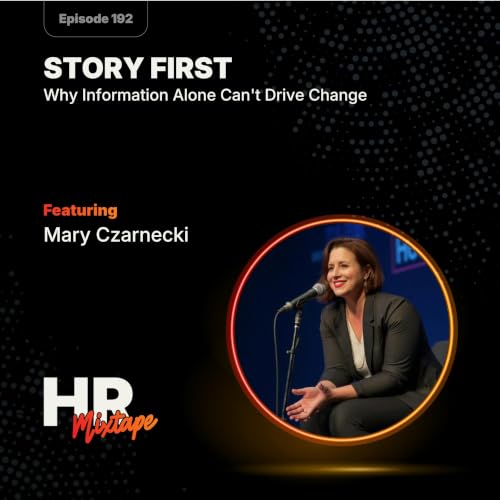
  • Story First: Why Information Alone Can't Drive Change
    Jul 21 2026
    Most change initiatives fail not because the strategy was wrong but because the communication didn't move anyone. HR leaders deliver their message, check the box, and wonder why nothing shifted. The problem almost never lives in the data. It lives in the absence of story. Mary Czarnecki, Brand Messaging Consultant at Mary Czarnecki LLC, spent more than two decades in marketing and strategy at Johnson & Johnson, WebMD, and Accenture before building a practice that trains leaders at Fortune 500 companies to use story as a practical tool for influence and organizational change. In this episode, she covers: Why more information alone can't produce behavior change, and what story does that information can't How to identify where people are getting stuck before looking for a story, so the narrative actually closes the right gap The three ingredients in any story that actually lands: a specific moment, sensory details, and a clear arc from before to after Timestamps [00:00:16] What it means to help leaders turn ideas into influence, and why storytelling is the vehicle [00:01:49] Why change initiatives fail because of communication, not strategy, and how story closes that gap [00:02:31] The first step in storytelling most leaders skip: identifying what someone isn't getting before finding a story [00:04:11] What the HR Story Advantage actually means, and why knowing the facts about a habit doesn't create the habit [00:07:47] How to find the right story when you're the messenger, not the creator of the message [00:09:43] Balancing transparency and oversharing: the audience-centric gut check that keeps stories from backfiring [00:12:47] The bad perm story: a client example of how a personal, humble story got an entire sales team to bring their own stories [00:16:42] Where AI helps with storytelling and the one trap to avoid when using it [00:18:10] The most common communication mistake leaders make today: building a message without putting yourself in the audience's shoes first [00:19:29] The treasure trove habit: why the best communicators don't find stories on demand, they collect them over time Brought to You by Paylocity Paylocity is the fastest growing unified platform for HR, Finance, and IT. Paylocity brings your people, processes, and data together in one place so HR leaders can spend less time managing systems and more time doing the work that actually moves their organizations forward. Learn more at paylocity.com Keywords: storytelling, leadership communication, change management, HR strategy, influence without authority, organizational change, internal communication, narrative, employee engagement, communication skills, HR leadership, people strategy, trust building, audience-centric communication, Mary Czarnecki, behavior change, change communication, HR story advantage, story structure, workplace storytelling
    Mehr anzeigen Weniger anzeigen
    21 Min.
  • Shatter the Limit: Building Resilient Leaders Who Thrive in the Uncomfortable
    Jul 14 2026
    Most organizations assume they have resilient teams. What they actually have, in a lot of cases, are teams that have gotten good at tolerating hard things. The two aren't the same, and the gap becomes visible the moment something real changes. Aaron Golub, founder of Aaron Golub Consulting, made history as the first legally blind Division I athlete to play in a Division I game, serving as team captain at Tulane University before signing with the NFL as a free agent. He's been translating that lived experience into leadership development work since the age of 17. In this episode, he covers: • Why acceptance is the prerequisite to any real change, and how skipping it is the reason most leadership development doesn't stick • How to read what each person on your team actually needs, and why applying the same leadership approach to everyone is the core mistake • Why the next generation of leaders is too comfortable, and what that costs organizations when pressure finally arrives Timestamps [00:00:16] Aaron Golub's origin story: how becoming the first legally blind Division I athlete became a leadership framework, not just a personal victory [00:01:10] Why the football story is the vehicle, not the point, and how Aaron translates a personal resilience model into organizational change [00:02:16] The acceptance principle: why you can't form new perspectives around a challenge you haven't first acknowledged as real [00:03:57] What leading a Division I football team taught Aaron about the danger of applying one leadership style to every person [00:06:48] Why every engagement starts with a needs assessment, and why skipping it makes the work ineffective regardless of how good the content is [00:08:18] Gratitude-based leadership: why positivity and negativity both spread through an organization, and the four-step framework that gets you there [00:11:00] Why inclusion starts with asking, not assuming, and the airport wheelchair story that shows what happens when you don't [00:13:10] Aaron's case against automatic visual descriptions in meetings, and why well-intentioned practices can create the tension they're meant to prevent [00:17:14] Why the next generation of leaders is too comfortable, and what organizations lose because of it [00:20:42] Aaron's final takeaway: reframing "I can't" to "I haven't been able to yet," and why the language shift is the strategy Guest Bio Aaron Golub is a professional speaker, entrepreneur, and consultant who specializes in helping to shatter perceived limitations. He made history as the first legally blind Division I athlete to play in a game, serving as a team captain at Tulane University before moving on to the NFL as a free agent. After his story captured the national spotlight on Good Morning America, Aaron realized his journey wasn't just about football, it was a blueprint for resilience. Since the age of 17, he has traveled the globe delivering high-impact strategies that challenge teams to rethink their "impossible" and take immediate action. Aaron doesn't just deliver a keynote and leave; he is a dedicated partner who works alongside leadership to implement lasting change and ensure insights turn into results. Brought to You by Paylocity Paylocity is the fastest growing unified platform for HR, Finance, and IT. Paylocity brings your people, processes, and data together in one place so HR leaders can spend less time managing systems and more time doing the work that actually moves their organizations forward. Learn more at paylocity.com paylocity.com Keywords resilience, limiting beliefs, leadership development, gratitude-based leadership, inclusion, disability in the workplace, people management, team building, change management, performance management, employee engagement, psychological safety, workplace culture, HR strategy, personal development, adversity, blind athlete, resilient teams, organizational change, discomfort
    Mehr anzeigen Weniger anzeigen
    22 Min.
adbl_web_anon_alc_button_suppression_t1
Noch keine Rezensionen vorhanden