EP Edge Journal Watch: Cardiac Electrophysiology Research omslagsbild

EP Edge Journal Watch: Cardiac Electrophysiology Research

EP Edge Journal Watch: Cardiac Electrophysiology Research

Av: Niraj Sharma MD FACC FHRS: Cardiac Electrophysiology & Cardiology
Lyssna kostnadsfritt nu, utan abonnemang

Das größte Angebot der Saison | 0,99 € pro Monat für die ersten 3 Monate + 15 € Audible-Guthaben

Danach 6,99 €/Monat. Bedingungen gelten. Monatlich kündbar.
Om den här titeln
Welcome to EP Edge Journal Watch, where cardiac electrophysiology meets evidence, precision, and perspective. Hosted by Dr. Niraj Sharma, this weekly podcast distills high-impact cardiovascular and Cardiac Electrophysiology and arrhythmia research into clear, clinically meaningful insights. Each episode goes beyond headlines and abstracts to uncover what new studies actually mean for patient care, decision-making, and the future of electrophysiology. What EP Edge Journal Watch stands for: Evidence-based practice Precision electrophysiology, arrhythmias analysis A forward-thinking, edge-driven approach to how we interpret and apply data in real-world clinical settings. Whether you’re an electrophysiologist, cardiologist, researcher, trainee, or allied health professional, EP Edge Journal Watch brings you the signal not the noise. Expect sharp summaries, thoughtful commentary, and practical takeaways designed for the busy clinician who wants to stay ahead of the curveEP Edge Hygiene & gesundes Leben Wissenschaft
Avsnitt
  • EP Edge® Journal Watch, Issue 46, November 2026: AF Ablation, Cardiac Resynchronization and Stroke Prevention, Part 1
    Nov 23 2026
    Short previewWhen does better rhythm control translate into better symptoms? EP Edge and LAHRS revisit the 2026 evidence on atrial fibrillation ablation, pacing for heart failure and left atrial appendage closure.Episode descriptionIn Part 1 of our 2026 electrophysiology review, EP Edge and the Latin American Heart Rhythm Society (LAHRS) revisit decisions that come up in the EP clinic and lab. Should a patient with persistent atrial fibrillation (AF) start with pulsed field ablation or an antiarrhythmic drug? If ablation is chosen, what justifies treating tissue beyond the pulmonary veins?First-line ablation and the posterior wallIn AVANT GUARD, estimated 12-month success on the composite rhythm-control endpoint was 56% with ablation and 30% with drug therapy. Yet the same ten-minute AF episode counted as a recurrence if the patient felt it and fell below the one-hour threshold if it was silent. We examine six procedural strokes before the trial pause, the subsequent changes to patient selection and anticoagulation, and why zero strokes among the 74 patients treated afterward leaves uncertainty about safety. AVANT GUARDPIFPAF-PFA found no significant improvement in its primary recurrence endpoint with routine posterior wall isolation. IDEAL-AF found greater freedom from arrhythmia off antiarrhythmic drugs when additional radiofrequency ablation targeted mapped low-voltage tissue in patients who met its mapping criteria. PIFPAF-PFA · IDEAL-AFCardiac resynchronization in heart failureBrazil’s PhysioSync-HF favored biventricular pacing on an outcome that prioritized death and worsening heart failure. HeartSync-LBBP found fewer deaths or heart failure hospitalizations with left bundle branch pacing, driven mainly by fewer hospitalizations. His-Alternative II measured the reduction in left ventricular end-systolic volume at six months. We discuss why confirming conduction system capture matters when applying these results. PhysioSync-HF · HeartSync-LBBP · His-Alternative IILeft atrial appendage closure and stroke preventionCHAMPION-AF met its noninferiority criterion for cardiovascular death, stroke or systemic embolism in patients eligible for anticoagulation. How much does meeting that composite endpoint tell us about stroke prevention itself? We examine Anish Shah and colleagues’ Heart Rhythm viewpoint using historical placebo data, then turn to CLOSURE-AF, where closure failed to demonstrate noninferiority to medical therapy in patients at high risk of both stroke and bleeding. CHAMPION-AF · Shah viewpoint · CLOSURE-AFWhat patients feel after ablationPVI-SHAM-AF, PFA-SHAM and the earlier SHAM-PVI all found better rhythm outcomes with ablation. PFA-SHAM and SHAM-PVI also found a quality-of-life benefit. In PVI-SHAM-AF, the primary six-month quality-of-life comparison fell short of statistical significance. We look at baseline symptoms, beta-blocker use and the care patients received after a sham procedure. PVI-SHAM-AF · PFA-SHAM · SHAM-PVIBEAT PAROX-AF compared pulsed field with radiofrequency ablation in paroxysmal AF. Pulsed field ablation shortened procedure time without demonstrating superior rhythm control. BEAT PAROX-AFAF burden, AF density and ischemic strokeOne continuous day of AF and one hour on each of 24 days give the same burden over a month. Does the clustering of those hours matter? We close with the device-monitoring study by Lindsey Rosman and colleagues, its corrected one-year stroke estimates and the limits of using this observational association to guide anticoagulation for an individual patient. AF density study · Published correction · Authors’ replyPart 2 of the annual review is planned for January 2027. Regular weekly Journal Watch coverage continues in the meantime.
    Visa mer Visa mindre
    37 min
  • EP Edge® Journal Watch 45, November 2026: Pulsed Field Ablation for AF, Pacing, Cannabis and Anticoagulation
    Nov 16 2026
    Does a shorter atrial fibrillation ablation give patients the same chance of staying in sinus rhythm a year later? In Issue 45 of EP Edge® Journal Watch, Dr. Niraj Sharma reviews 16 electrophysiology publications, from choosing an ablation catheter to deciding whether a patient with AF and a remote coronary stent still needs aspirin.TWOSOME | Single-shot vs point-by-point pulsed field ablationIn 100 patients undergoing their first pulmonary vein isolation for paroxysmal AF, median procedure time was 43 minutes with single-shot PFA and 118 minutes with focal PFA. At 12 months, estimated freedom from AF or atrial tachycardia off antiarrhythmic drugs was 76% versus 82% (P = .46). The trial was too small to establish equivalence. Both groups received PFA for pulmonary vein isolation. Operators used radiofrequency only for additional flutter ablation. Hartl et al. · DOI 10.1016/j.hrthm.2026.04.049Conduction system pacing | Who is at risk for pacing-induced cardiomyopathy?Lozano-Torres and colleagues studied 678 conventional pacemaker recipients with preserved baseline left ventricular ejection fraction. Their five-year risk model weights four measurements: native QRS duration, starting ejection fraction, left ventricular end-diastolic diameter and right ventricular pacing burden. Dr. Sharma walks through a patient example to explain how the estimated risk changes when more beats are paced. The benefit of choosing upfront conduction system pacing for a patient with a high score remains an open question. Lozano-Torres et al. · DOI 10.1016/j.hrthm.2025.10.051MARY-JANE | Inhaled cannabis, palpitations and cardiac ectopyAmong 108 habitual cannabis users, the daily ectopy rate was 9% lower on days assigned to inhalation than on days assigned to abstinence (rate ratio 0.91, 95% CI 0.85–0.98). Premature atrial contractions drove the difference. Step count, sleep duration and mean glucose showed no clear changes. Two companion pieces examine what this means for a patient reporting palpitations. Benowitz considers what a daily count can miss in the minutes after inhalation. Khurshid asks how withdrawal, adherence and nicotine use complicate attribution to THC. Elias trial · DOI 10.1016/j.jacc.2026.07.014 · Benowitz editorial · DOI 10.1016/j.jacc.2026.07.035 · Khurshid editor’s note · DOI 10.1016/j.jacc.2026.08.009Anticoagulation in stable coronary artery disease | Does the patient still need an antiplatelet?Gargiulo and colleagues pooled six randomized trials involving 5,924 patients. Five trials contributed to the major bleeding estimate, which favored oral anticoagulation alone over anticoagulation plus one antiplatelet agent (HR 0.46, 95% CI 0.32–0.66). Only three trials informed the stent-thrombosis estimate, leaving greater uncertainty about that rare outcome. We discuss why the date and indication for coronary intervention matter before changing either prescription. Gargiulo et al. · DOI 10.1016/j.jacc.2026.01.026Also in this episodePersistent AF ablation and PFA safety. Kaige Li examines electrogram-guided ablation after pulmonary vein and posterior wall isolation. Hammadeh analyzes adverse-event reports for four PFA systems. Hauser uses the historical Sprint Fidelis ICD lead experience to explain when a reporting signal warrants investigation. Kaige Li · DOI 10.1016/j.hrthm.2026.03.1878 · Hammadeh · DOI 10.1016/j.hrthm.2026.07.032 · Hauser · DOI 10.1016/j.hrthm.2026.07.033AF phenotypes, sleep apnea and cognition. A CABANA secondary analysis asks whether clinical profiles identify different benefits from ablation. ACaSA examines whether severe sleep apnea precedes new AF or accompanies an ongoing episode. Concussion AF tests whether five serum biomarkers—GFAP, S100B, neuron-specific enolase, tau and SNT145—identify older patients whose cognition declines. Wenhui Li · DOI 10.1016/j.hrthm.2026.07.008 · Spitaler · DOI 10.1016/j.hrthm.2026.07.026 · Bunch · DOI 10.1016/j.hrthm.2026.07.019Conduction disease and atrial pacing. Goings tracks left ventricular ejection fraction after new native left bundle branch block. Yamashita identifies paced P-wave features that help operators recognize Bachmann bundle capture. Goings · DOI 10.1016/j.hrthm.2025.11.026 · Yamashita · DOI 10.1016/j.hrthm.2026.05.012AF risk and stroke prevention. Xu examines HDL particle size, lipid-lowering therapy and incident AF. Shah revisits CHAMPION-AF to ask how much of anticoagulation’s stroke protection the trial’s noninferiority margin required left atrial appendage closure to preserve. Xu · DOI 10.1016/j.hrthm.2025.11.021 · Shah viewpoint · DOI 10.1016/j.hrthm.2026.07.048The episode also previews our collaboration with the Latin American Heart Rhythm Society at its November 18–20 congress in Mexico City. Look for the first joint issue on November 22 as the discussion expands in English and Spanish. LAHRS CongressRead the full clinical appraisals, eligibility criteria and study infographics in the ...
    Visa mer Visa mindre
    28 min
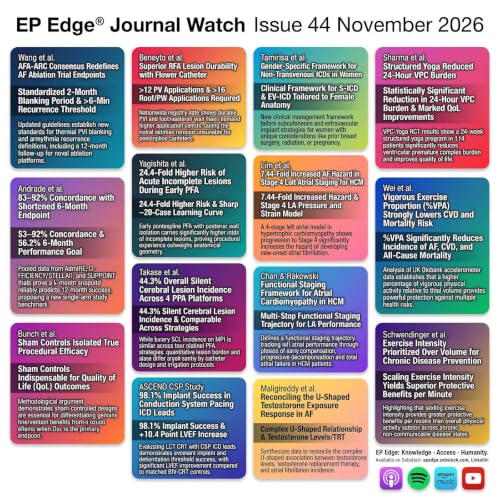
  • EP Edge® Journal Watch 44, November 2026: AF Ablation Endpoints, Conduction System Pacing and Exercise
    Nov 9 2026
    EP Edge® Journal Watch 44, November 2026: AF Ablation Endpoints, Conduction System Pacing and ExerciseWhat should count as successful atrial fibrillation ablation? Can shorter follow-up reliably assess treatment effectiveness? How might conduction system pacing, atrial physiology, and exercise intensity influence the way we evaluate and manage arrhythmia risk?In Issue 44 of EP Edge® Journal Watch, Dr. Sharma examines five featured publications in depth, explaining their rationale, methods, findings, statistical interpretation, limitations, and practical implications. The episode also provides brief assessments of the remaining publications, with comprehensive analyses and infographics available in the newsletter.Designed for electrophysiologists, cardiologists, trainees, and clinicians interested in cardiovascular research, this episode connects the evidence to the decisions it can reasonably inform.FEATURED DISCUSSIONSAF ablation endpoints: why six minutes, and why two months of blanking?Wang and colleagues’ Academic Research Consortium report proposes a framework for evaluating atrial fibrillation ablation effectiveness and safety. We examine the rationale behind the six-minute recurrence threshold, the two-month blanking period, and the distinction between device detection and adjudicated trial outcomes. The discussion also covers AF burden, medication exposure, monitoring intensity, follow-up duration, and safety assessment for emerging technologies.Wang PJ, et al. Atrial Fibrillation Ablation Effectiveness End Points, Safety End Points, and Trial Design: Academic Research Consortium Initiative Endorsed by the Heart Rhythm Society. Circulation: Arrhythmia and Electrophysiology. 2026.DOI: https://doi.org/10.1161/CIRCEP.126.015082Can six-month outcomes predict twelve-month ablation success?Andrade and colleagues analyze 905 patients from four prospective studies. Agreement between shorter and conventional endpoints was high, but sensitivity for identifying conventional failures ranged from 57% to 76%. We explain why accurate population estimates do not necessarily mean accurate individual classification, and distinguish this six-month total assessment from the consortium’s eight-month recommendation for established technologies in paroxysmal AF.Andrade JG, et al. Incorporating a Shortened Long-Term Effectiveness End Point Into Catheter Ablation Trials: Statistical Properties and Implications. Circulation: Arrhythmia and Electrophysiology. 2026.DOI: https://doi.org/10.1161/CIRCEP.125.014773Conduction system pacing and defibrillation: what does ASCEND CSP establish?Varma and colleagues evaluate a dedicated conduction system pacing defibrillation lead used with a coronary sinus left ventricular lead. We discuss implantation success, capture, electrical performance, defibrillation testing, and ventricular remodeling. Encouraging findings are considered alongside missing paired imaging, background therapy, and the limitations of comparison with a historical matched cohort.Varma N, et al. Cardiac Resynchronization Therapy Using a Conduction System Pacing Defibrillation Lead in Patients Meeting CRT-D Indications: Six-Month Clinical Outcomes Results From the ASCEND CSP Study. JACC: Clinical Electrophysiology. 2026.DOI: https://doi.org/10.1016/j.jacep.2026.10.003Hypertrophic cardiomyopathy: looking beyond left atrial sizeLim and colleagues combine estimated atrial pressure and contractile function to characterize future AF risk. We explain the physiological stages, the increasing incidence of AF, external validation, and the incremental improvement in prediction. Better risk discrimination does not yet establish a stage-based monitoring schedule or treatment threshold.Lim J, et al. Physiological Left Atrial Staging and the Risk of New-Onset Atrial Fibrillation in Hypertrophic Cardiomyopathy. Journal of the American College of Cardiology. 2026.DOI: https://doi.org/10.1016/j.jacc.2026.08.014Chan and Rakowski’s companion editorial examines why stronger atrial contraction may represent compensation against a stiff ventricle rather than preserved atrial health.Chan RH, Rakowski H. Atrial Cardiomyopathy in Hypertrophic Cardiomyopathy: From Compensation to Atrial Fibrillation. Journal of the American College of Cardiology. 2026.DOI: https://doi.org/10.1016/j.jacc.2026.09.002Exercise intensity, new-onset AF, and chronic diseaseWei and colleagues investigate whether vigorous activity contributes information beyond total activity volume. The AF association weakened from approximately 29% to 17% lower relative hazard after additional adjustment. We explain the exposure measure, the apparent plateau, and why these findings do not establish an exercise prescription for established AF or other arrhythmias.The discussion also examines associations with major cardiovascular events, diabetes, dementia, inflammatory disease, metabolic liver disease, respiratory disease, kidney disease, and mortality. Observational ...
    Visa mer Visa mindre
    28 min
adbl_web_anon_alc_button_suppression_t1
Inga recensioner ännu