

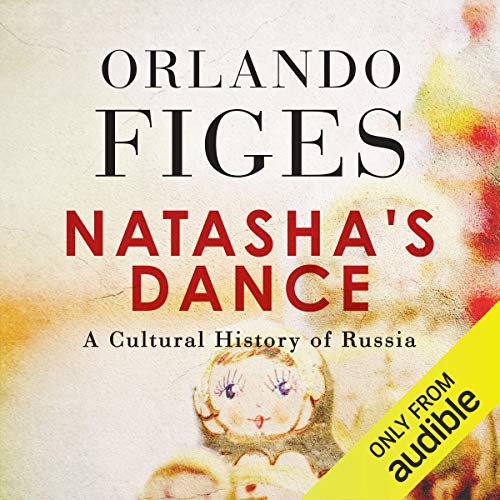
Natasha's Dance
A Cultural History of Russia
Nie udało się dodać produktów
Nie udało się dodać tytułu do koszyka.
Nie udało się dodać tytułu do schowka.
„Usuń ze schowka“ nie powiodło się.
„Obserwuj podcast“ nie powiodło się
„Przestań obserwować podcast“ nie powiodło się
Wypróbuj Audible Standard bezpłatnie przez 30 dni

Natasha's Dance
Kup za 32,70 €
-
Czyta:
-
Ric Jerrom
-
Autor:
-
Orlando Figes
History on a grand scale - an enchanting masterpiece that explores the making of one of the world's most vibrant civilizations.
A People's Tragedy, wrote Eric Hobsbawm, did 'more to help us understand the Russian Revolution than any other book I know'.
Now, in Natasha's Dance, internationally renowned historian Orlando Figes does the same for Russian culture, summoning the myriad elements that formed a nation and held it together.
Beginning in the 18th century with the building of St. Petersburg - a 'window on the West' - and culminating with the challenges posed to Russian identity by the Soviet regime, Figes examines how writers, artists and musicians grappled with the idea of Russia itself - its character, spiritual essence and destiny.
He skillfully interweaves the great works - by Dostoevsky, Stravinsky, and Chagall - with folk embroidery, peasant songs, religious icons and all the customs of daily life, from food and drink to bathing habits to beliefs about the spirit world.
Figes' characters range high and low: the revered Tolstoy, who left his deathbed to search for the kingdom of God, as well as the serf girl Praskovya, who became Russian opera's first superstar and shocked society by becoming her owner's wife.
Like the European-schooled countess Natasha performing an impromptu folk dance in Tolstoy's War and Peace, the spirit of 'Russianness' is revealed by Figes as rich and uplifting, complex and contradictory - a powerful force that unified a vast country and proved more lasting than any Russian ruler or state.
©2018 Orlando Figes (P)2018 Audible, LtdTe tytuły mogą Ci się spodobać





The book offers a broad picture of cultural evolution of Russia seen “from outside”, hence less bias due to current “internal” propaganda and cultural inner habits. In the end, the author might have understood Russians better than they do themselves.
A pity, that a potential audience for the book is not large. It does not attract people, who does not have an genuine interest in the russian culture, it is too extensive. Russians themselves might show certain arrogance “how he can understand us, a foreigner!” or being unable to read it in English.
The only negative comment about the book is that the narrator was not provided with phonetic instructions for rusdian words, names and titles. Virtually none if them is pronounced correctly.
View from outside
Coś poszło nie tak. Spróbuj ponownie za kilka minut.
Great history of russian art and artists
Coś poszło nie tak. Spróbuj ponownie za kilka minut.
Ohne die Möglichkeit, die Wiedergabegeschwindigkeit deutlich zu erhöhen, hätte aber sicher nicht durchgehalten. Ric Jerrom liest so betulich, dass ich bis auf 1,4 gehen musste.
Ein gewaltiger Steinbruch ...
Coś poszło nie tak. Spróbuj ponownie za kilka minut.