
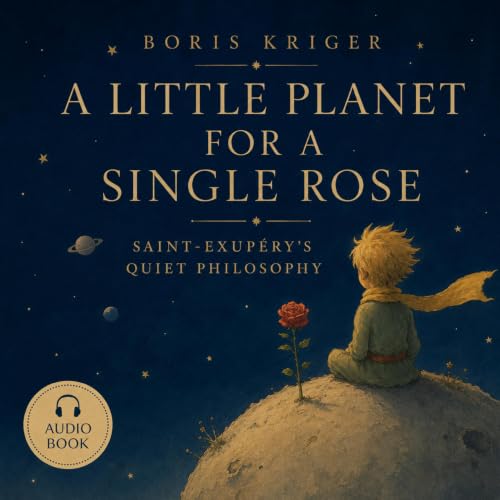
A LITTLE PLANET FOR A SINGLE ROSE: SAINT-EXUPÉRY'S QUIET PHILOSOPHY okładka

A LITTLE PLANET FOR A SINGLE ROSE: SAINT-EXUPÉRY'S QUIET PHILOSOPHY

Posłuchaj fragmentu

Wypróbuj Audible Standard bezpłatnie przez 30 dni

Następnie 6,99 € za miesiąc. W każdej chwili możesz anulować subskrypcję
Wypróbuj za 0,00 €
Więcej ofert

A LITTLE PLANET FOR A SINGLE ROSE: SAINT-EXUPÉRY'S QUIET PHILOSOPHY

Autor: Boris Kriger
Czyta: Nicole
Wypróbuj za 0,00 €

Po 30 dniach okresu próbnego koszt subskrypcji będzie wynosił 6,99 €/miesiąc a subskrypcja będzie odnawiana automatycznie. Subskrypcję można anulować w każdej chwili.

Kup za 13,95 €

Kup za 13,95 €

Saisonale Sparangebote | 0,99 € pro Monat für die ersten 3 Monate

Danach 6,99 €/Monat. Bedingungen gelten. Monatlich kündbar.
Eighty years after Antoine de Saint-Exupéry vanished over the Mediterranean, his small book about a boy with golden hair, a single rose, and a fox who taught him what the word "tame" really means continues to outsell almost every other work of literature on Earth. It is read by children who follow only the pictures, by lovers who quote the Fox to one another, by mourners who recognize the Snake at last, by philosophers who slowly come to suspect that this slim volume has quietly said what their thick volumes have been trying to say for centuries.This book is a long, patient reading of The Little Prince — not as a piece of children's literature, and not as a sentimental classic, but as one of the most concentrated works of philosophy of the twentieth century. It begins with Saint-Exupéry himself: the night pilot over the Sahara, the exile in a Manhattan apartment in 1942, the airman who took off on the last of July 1944 and never came down. It moves slowly through the asteroids and the desert, opening every figure the boy meets — the King without subjects, the lamplighter faithful to a useless duty, the businessman counting stars he will never own, the Fox who asks to be tamed, the Snake who returns him home. It then steps back into the great themes the book quietly carries: how we see with the heart, how love becomes responsibility, how a single rose becomes unrepeatable, how loneliness drives the soul outward, how letting go is not the opposite of love but one of its forms. Finally, it traces Saint-Exupéry's quiet philosophy through the long conversations of Western and Eastern thought — Plato and Lao Tzu, the Stoics and the Christians, Kant and Buber, Rousseau and Nietzsche, Husserl, Sartre, Heidegger, Camus, Simone Weil — and shows how this little book has been, all along, in dialogue with all of them.©2026 Boris Kriger (P)2026 Boris Kriger Filozofia
adbl_web_anon_alc_button_suppression_t1
Brak recenzji