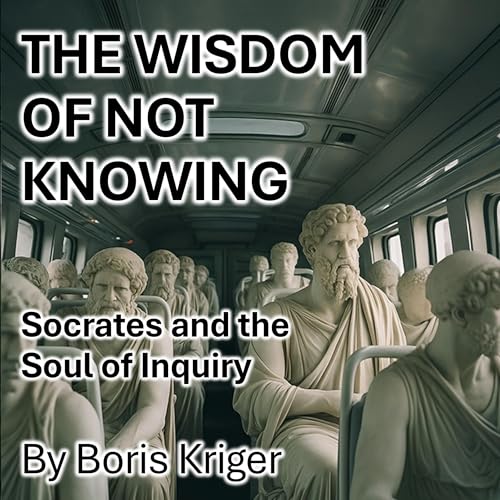
The Wisdom of Not Knowing
Socrates and the Soul of Inquiry (Philosophical Questions)
Impossible d'ajouter les articles
Impossible d'ajouter le titre au panier.
Impossible d'ajouter le titre à la liste d'envies.
«Retirer de la liste d'envies» a échoué.
Échec de « Suivre le podcast »
Échec de «Ne plus suivre le podcast»
0,99 €/mois pendant 3 mois + 15 € de crédit Audible

The Wisdom of Not Knowing
Acheter pour 13,66 €
-
Lu par :
-
Chris Reynolds
-
De :
-
Boris Kriger
The Wisdom of Not Knowing is not a return to ancient philosophy, but a reinvention of it. This book does what neither classical thinkers nor modern theorists ever attempted: it brings Socrates into the twenty-first century and forces him to confront ideas, crises, and forms of consciousness that lie far beyond the horizon of Athens. Its originality lies not in commentary, but in creation — a new architecture of thought built from the friction between worlds that were never meant to meet.
Here, dialogue becomes a philosophical instrument rather than a literary device. Socrates encounters Lao Tzu, the Buddha, Descartes, Kant, Nietzsche, Lacan, Deleuze, and artificial intelligence — not to seek agreement, but to test the limits of their visions. Each conversation functions as an experiment in thinking, revealing what remains alive in these traditions and what collapses under the pressure of Socratic inquiry. The result is neither a summary of ideas nor an homage to the past, but the emergence of a new space where philosophy is rebuilt from its contradictions.
The book’s originality lies in its daring synthesis. Eastern emptiness meets Western dialectic; ancient elenchus meets post-structuralist fragmentation; metaphysical silence confronts the algorithmic logic of machines. Out of these collisions arises a new conception of wisdom — one that treats ignorance not as a deficit, but as a generative force, a creative tension that opens thought rather than closes it.
Continue the series