

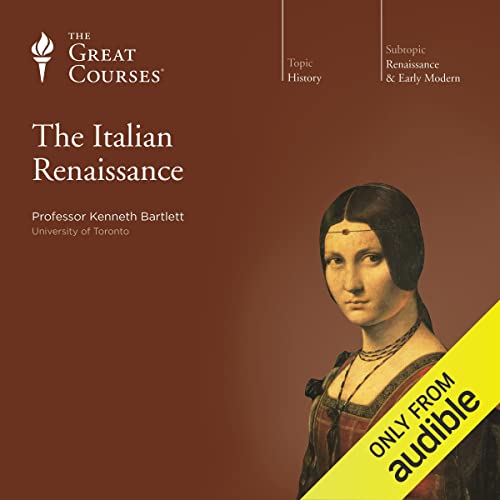
The Italian Renaissance
Det gick inte att lägga till artiklar
Titeln kunde inte läggas till i kundvagnen.
Titeln kunde inte läggas till i Önskelistan.
„Ta bort från Önskelista“ misslyckades.
„Följ podcast“ misslyckades
„Sluta följa podcast“ misslyckades
Prova Audible Standard kostnadsfritt i 30 dagar

The Italian Renaissance
Köp för 22,09 €
-
Berättare:
-
Kenneth R. Bartlett
The effects of the Italian Renaissance are still with us today, from the incomparable paintings of Leonardo da Vinci to the immortal writings of Petrarch and Machiavelli. But why was there such an artistic, cultural, and intellectual explosion in Italy at the start of the 14th century? Why did it occur in Italy? And why in certain Italian city-states such as Florence?
Professor Bartlett probes these questions and more in 36 dynamic lectures. This is your opportunity to appreciate the results of the Italian Renaissance and gain an understanding of the underlying social, political, and economic forces that made such exceptional art and culture possible. At the heart of Renaissance Italy were the city-states, home to the money, intellect, and talent needed for the growth of Renaissance culture. You'll look at the Republic of Florence, as well as other city-states that, thanks to geographical and historical circumstances, had much different political and social structures. This course contains a wealth of details that will give you a feel and appreciation for the Italian Renaissance - its contributions to history, the ways it was similar and dissimilar to our times, and how the people of the time, both famous and ordinary, experienced it. You'll come away surprised by how much of our modern life was made possible by the Renaissance. Our concept of participatory government, our belief in the value of competition, our philosophy of the content and purpose of education, even our notions of love all have roots in the Renaissance period. Its loftiest ideals - the importance of the individual, the value of human dignity and potential, and the promotion of freedom - are ones we embrace as our own.
PLEASE NOTE: When you purchase this title, the accompanying reference material will be available in your Library section along with the audio.
©2005 The Teaching Company, LLC (P)2005 The Great CoursesDessa titlar kanske intresserar dig




Continue the series


By far better than the other “great Courses” lectures on the renaissance.
Best Renaissance lecture on Audible
Ett fel uppstod. Försök igen om några minuter.
Die 24 Stunden waren nicht genug, wenn auch inhaltlich geschlossen.
Super interessant
Ett fel uppstod. Försök igen om några minuter.
On another note the lecturer makes a point of defending the monarchies within the Italian Renaissance by stating that “sometimes even women ruled”, which though true, misdirects from this being an exception of the rule and brushes over the reality of 99% of the rest of the female population’s fate.
These two points aside, I greatly enjoyed this lecture and was often excited and moved by the way the lecturer conveys the tides of history.
Wonderful lecture
Ett fel uppstod. Försök igen om några minuter.