

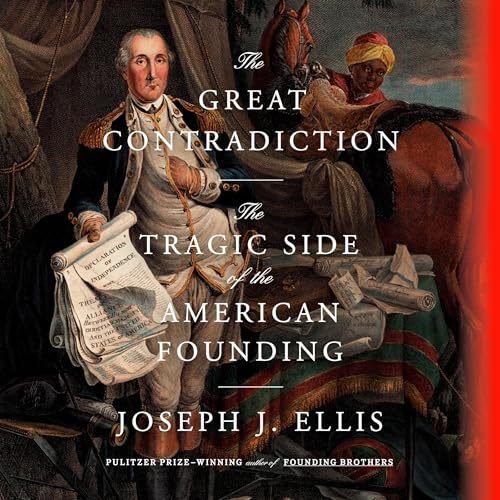
The Great Contradiction
The Tragic Side of the American Founding
Impossible d'ajouter les articles
Désolé, nous ne pouvons pas ajouter cet article car votre panier a atteint sa capacité maximale.
Impossible d'ajouter le titre au panier.
Veuillez réessayer plus tard
Impossible d'ajouter le titre à la liste d'envies.
Veuillez réessayer plus tard
«Retirer de la liste d'envies» a échoué.
Veuillez réessayer plus tard
Échec de « Suivre le podcast »
Échec de «Ne plus suivre le podcast»
0,99 €/mois pendant 3 mois + 15 € de crédit Audible
Renouvellement automatique à 6,99 €/mois après 3 mois. Annulation mensuelle possible.
L'offre prend fin le 28 décembre 2026.

The Great Contradiction
Lu par :
Kimberly Farr
Acheter pour 17,88 €
-
Lu par :
-
Kimberly Farr
-
De :
-
Joseph J. Ellis
À propos de ce titre
An astounding look at how America’s founders—Washington, Jefferson, Franklin, Madison, Adams—regarded the issue of slavery as they drafted the Declaration of Independence and the Constitution. A daring and important work that ultimately reckons with the two great failures of America’s founding: the failure to end slavery and the failure to avoid Indian removal.
On the eve of the American Revolution, half a million enslaved African Americans were embedded in the North American population. The slave trade was flourishing, even as the thirteen colonies armed themselves to defend against the idea of being governed without consent. This paradox gave birth to what one of our most admired historians, Joseph J. Ellis, calls the “great contradiction”: How could a government that had been justified and founded on the principles articulated in the Declaration of Independence institutionalize slavery? How could it permit a tidal wave of western migration by settlers who understood the phrase “pursuit of happiness” to mean the pursuit of Indian lands?
With narrative grace and a flair for irony and paradox, Ellis addresses the questions that lie at America’s twisted roots—questions that turned even the sharpest minds of the Revolutionary generation into mental contortionists. He discusses the first debates around slavery and the treatment of Native Americans, from the Constitutional Convention to the Treaty of New York, revealing the thinking and rationalizations behind Jay, Hamilton, and Madison’s revisions of the Articles of Confederation, and highlights the key role of figures like Quaker abolitionist Anthony Benezet and Creek chief Alexander McGillivray.
Ellis writes with candor and deftness, his clarion voice rising above presentist historians and partisans who are eager to make the founders into trophies in the ongoing culture wars. Instead, Ellis tells a story that is rooted in the coexistence of grandeur and failure, brilliance and blindness, grace and sin.
* This audiobook edition includes a downloadable PDF with maps and charts from the book.
adbl_web_anon_alc_button_suppression_t1
Aucune critique pour le moment