

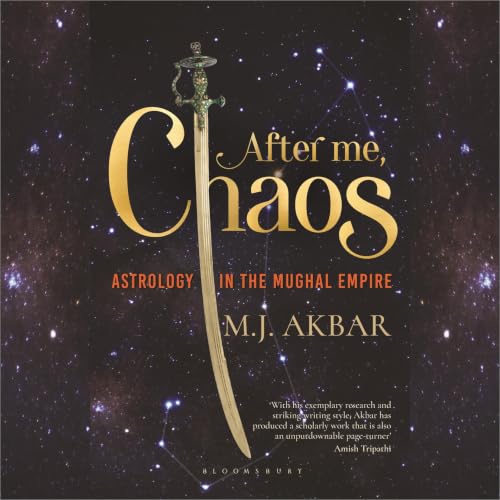
After Me, Chaos
Astrology in the Mughal Empire
Items couldn't be added
Sorry, we can't add the item as your basket has reached its capacity.
The title couldn't be added to your basket.
Please try again later.
Couldn't add title to Wish List
Please try again later.
‘Remove from Wish List’ failed
Please try again later.
Adding to library failed
Please try again
‘Follow podcast’ failed
‘Unfollow podcast’ failed
Free in your trial month
 Are you an Amazon Prime member?
 Try Audible free for 60 days
Start your free trial with the flexibility to pause or cancel monthly.
After your free trial, enjoy a diverse selection of audiobooks, children's audio dramas, and Audible Originals for €9.95 a month.
Choose 1 title a month from our entire catalogue and keep it.

After Me, Chaos
Narrated by:
Susheel Khan
Pre-order Now for €18.94
-
Narrated by:
-
Susheel Khan
-
By:
-
M.J. Akbar
The deep faith of Mughal kings in astrology has been hidden in plain sight, ignored by those who failed to understand its relevance. The evidence lies in original sources: commissioned biographies like Humayunnama and Akbarnama, autobiographies such as Baburnama and Tuzuk-i-Jahangir, records of imperial correspondence and court documents.
This belief went back to pre-Islamic cultural roots and the bloodlines of Chengiz Khan, descendant of the mother goddess Alanqoa. Akbar created the formal position of Jotik Rai, or royal astrologer, a post held for a century by Brahmin pundits from Benares who were gifted their weight in gold and silver as reward for an accurate forecast. In 1542 Humayun, then a hunted fugitive without hope, became certain that the Mughal empire would be reborn after reading his son Akbar’s horoscope.
Humayun wore clothes of different colours each day, as prescribed by planetary positions. Astrology was part of statecraft. In one instance, Akbar’s astrologer convinced him to march against Kashmir’s ruler Yousaf Shah Chak in 1586 when his commanders advised that the army’s passage through the mountains might be ruinous. Jahangir issued coins with a zodiac theme. Shahjahan took pride in the title Sahib-i-Qiran-i-Sani, or Lord of the Two Conjunctions.
Even Aurangzeb set aside his religiosity when it came to astrologers—they fixed the time of his two coronations. At the age of seventy-seven, Aurangzeb told his son Bahadur Shah that every single occurrence in his tempestuous life had been predicted in the horoscope cast at his birth. Every Mughal prince consulted astrologers to fix the auspicious time for the day’s appointments.©2025 M.J. Akbar (P)2027 Bloomsbury Publishing PLC
adbl_web_anon_alc_button_suppression_t1
No reviews yet