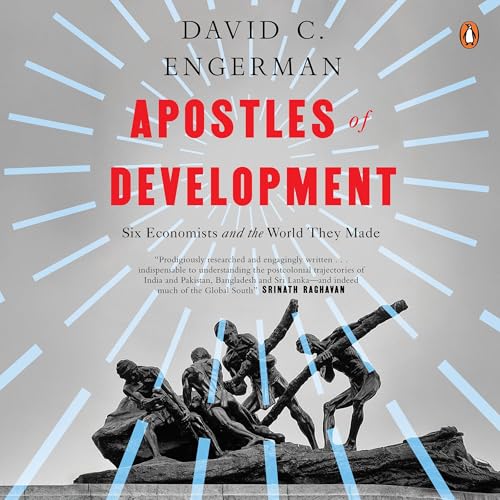
Apostles Of Development omslagafbeelding

Apostles Of Development

Beluister fragment
De grootste deal van het seizoen

€ 0,99 per maand voor 3 maanden + € 15 Audible-tegoed

Wordt automatisch verlengd voor € 6,99 per maand na 3 maanden. Maandelijks opzegbaar.
Profiteer van dit aanbod
Aanbieding geldig tot 28 december 2026.
Meer aanbiedingen

Apostles Of Development

Van: David C. Engerman
Verteld door: Abhishek Ajay Sharma
Profiteer van dit aanbod

Wordt automatisch verlengd voor € 6,99 per maand na 3 maanden. Maandelijks opzegbaar. De aanbieding eindigt op 28 december 2026.

Koop voor € 22,09

Koop voor € 22,09

De grootste deal van het seizoen | 3 maanden voor maar € 0,99 per maand + € 15 Audible-tegoed

Daarna € 6,99 per maand – voorwaarden zijn van toepassing. Maandelijks opzegbaar.
Over deze titel
The battle against global poverty that began after World War II was a major undertaking engaging economists, engineers, and organizations. Featuring front and centre were six remarkable economists: Amartya Sen, Manmohan Singh, Mahbub ul Haq, Jagdish Bhagwati, Rehman Sobhan, and Lal Jayawardena, all born as colonial subjects in the British Empire and studied at Cambridge University. They represented a new figure on the world scene —­ the Third World development expert­­ — and played a crucial role in global debates about poverty and development.Apostles of Development examines their different economic doctrines and the ongoing debate surrounding economic theory in poor countries compared to rich ones. The lives of these apostles reveal how development did not begin with textbooks but with real-world attempts to solve very specific and pressing problems. Finally, the book emphasizes that development was a Global South project first and foremost, aiming to improve the conditions of the world's poorest countries.It challenges the conventional wisdom that sees development only as a tool of rich countries to dominate, or as proof of their humanitarian spirit. It argues that development succeeds not when it follows ideological prescriptions, but when it looks for what works. The fading of grand visions shaped by ideological concerns has been one of the lasting effects of the end of the Cold War. The book argues that the best way forward is determined modesty, focusing on practical matters, such as addressing gross inequality and insisting that development means more than just economic growth. Given the salience of questions of economic inequality and the constant visibility of the promises and problems of economic development in the world today, this is a timely and important read. Business Economie Professionals & academici
adbl_web_anon_alc_button_suppression_t1
Nog geen reviews beschikbaar