

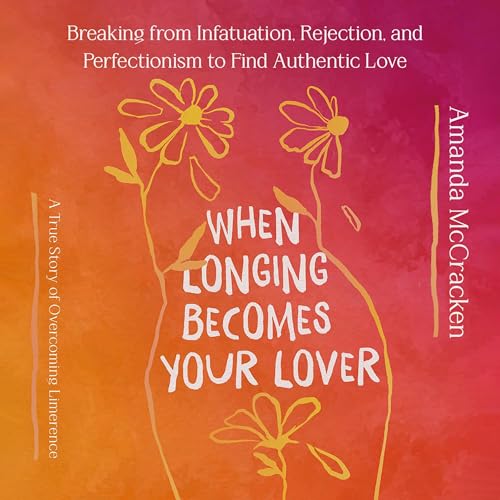
When Longing Becomes Your Lover
Breaking from Infatuation, Rejection, and Perfectionism to Find Authentic Love: A True Story of Overcoming Limerence
Impossible d'ajouter les articles
Désolé, nous ne pouvons pas ajouter cet article car votre panier a atteint sa capacité maximale.
Impossible d'ajouter le titre au panier.
Veuillez réessayer plus tard
Impossible d'ajouter le titre à la liste d'envies.
Veuillez réessayer plus tard
«Retirer de la liste d'envies» a échoué.
Veuillez réessayer plus tard
Échec de « Suivre le podcast »
Échec de «Ne plus suivre le podcast»
0,99 €/mois pendant 3 mois + 15 € de crédit Audible
Renouvellement automatique à 6,99 €/mois après 3 mois. Annulation mensuelle possible.
L'offre prend fin le 28 décembre 2026.

When Longing Becomes Your Lover
Lu par :
Amanda McCracken
Acheter pour 18,78 €
-
Lu par :
-
Amanda McCracken
-
De :
-
Amanda McCracken
À propos de ce titre
Journalist and late-in-life virgin Amanda McCracken dated over 100 men before she realized she was addicted to longing, setting her on a 10-year journey to understand the fallacies behind her beliefs about love, sex and commitment. She invites you along for the sometimes thrilling, sometimes heartbreaking, always insightful ride.
As Amanda endured one disappointment, letdown, and torpedoed fantasy after another, she began to understand that longing feels good. In fact, it can feel even better than actually being in love. Longing gives us a sense of control in our uncertain lives, and when we can always envision a more perfect relationship, we can ignore the very real problems that all relationships face. But longing can also become an addictive neurochemical boost that derails us from forming healthy, intimate relationships.
Amanda describes her early childhood hero fantasies and how they evolved in her tween and teen years into a commitment to the purity movement espoused at her church. As she grew into young womanhood, her obsession with an idealized version of love led her to become addicted to longing – constantly craving the ideal partner in the ideal location at the ideal time, reveling in the high of anticipating the sex she knew she wasn't going to have. It became a protective mechanism in a “sex positive” dating world that demands physical intimacy but admonishes emotional intimacy, where options seem plentiful but connections ambiguous.
In this searingly honest book, Amanda chronicles her many romantic encounters in today's dating world and what she learned about a concept called “limerence”: an obsessive rumination on a version of someone that doesn’t truly exist. Amanda weaves together her personal journey with research, storytelling, soul-searching questions, and quotes from experts and nonexperts alike to reveal the addictive nature of longing while providing hope through her journey of overcoming it and ultimately choosing of the path towards healthy, authentic intimacy.
adbl_web_anon_alc_button_suppression_t1
The result reads less like a book about limerence and more like an extended personal essay or column about one woman's relationship – mainly with herself. That's not inherently a problem, but it's marketed as something it isn't. The particularism of the narrator's experience, combined with the religious framing, makes it hard to generalise, identify with, or learn from. And ironically, writing a book this self-centred about a broader social phenomenon doesn't quite deflect the charge of princess syndrome…
Limerence Deserved Better
Une erreur s'est produite. Veuillez réessayer dans quelques minutes.