

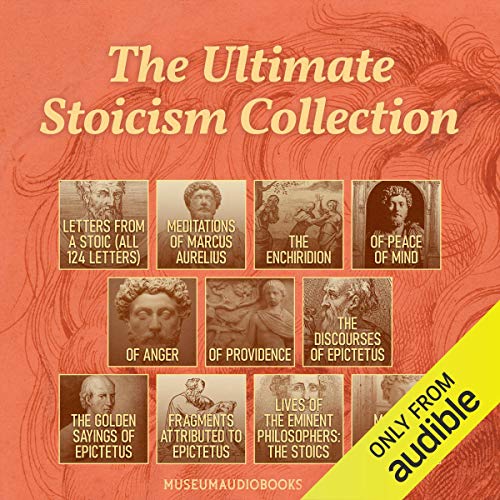
The Ultimate Stoicism Collection
Impossible d'ajouter les articles
Désolé, nous ne pouvons pas ajouter cet article car votre panier a atteint sa capacité maximale.
Impossible d'ajouter le titre au panier.
Veuillez réessayer plus tard
Impossible d'ajouter le titre à la liste d'envies.
Veuillez réessayer plus tard
«Retirer de la liste d'envies» a échoué.
Veuillez réessayer plus tard
Échec de « Suivre le podcast »
Échec de «Ne plus suivre le podcast»
0,99 €/mois pendant 3 mois + 15 € de crédit Audible
Renouvellement automatique à 6,99 €/mois après 3 mois. Annulation mensuelle possible.
L'offre prend fin le 28 décembre 2026.

The Ultimate Stoicism Collection
Lu par :
Museum Audiobooks cast
Acheter pour 35,85 €
-
Lu par :
-
Museum Audiobooks cast
À propos de ce titre
Stoicism, a school of Hellenistic thought founded in Athens in the third century BC, was one of the most sublime philosophies in the history of Western civilization. It is a way of living that focuses on reality instead of fantasy or idealism. According to its teachings, the path to peace and happiness is found in accepting the moment as it presents itself, by not allowing oneself to be ruled by the desire for pleasure or by the fear of pain.
The Ultimate Stoicism Collection includes:
- Letters from a Stoic (All 124 Letters) was written by Seneca during his retirement and sent to his friend Lucilius Junior, a procurator of Sicily. Seneca's major contribution to Stoicism was to humanize a system that could appear cold and unrealistic. The letters reveal how far in advance of his time Seneca's ideas were, for example his disgust at the shows in the Roman arena or his criticism of the treatment of slaves.
- Meditations of Marcus Aurelius is a series of personal writings by Marcus Aurelius, Roman emperor from 161 to 180 AD, recording his private notes to himself and ideas on Stoic philosophy.
- The Enchiridion is a collection of the most profound teachings of Epictetus who taught that philosophy is a way of life and not just a matter of theory. The Enchiridion is a canonical text of Stoic philosophy and contains all the fundamentals. Among them is the principle of not being concerned with that which is out of one’s control. Misfortune should not disturb the individual at all and should not be perceived negatively. Epictetus teaches that the only genuine value exists in virtuous action and accepting everything that happens in the world. He believed that one should do what is right and remain indifferent to criticism.
- Of Peace of Mind is a dialogue written by Seneca the Younger during the years 49 to 62 AD. It concerns the state of mind of Seneca's friend Annaeus Serenus, and how to cure Serenus of anxiety, worry, and disgust with life.
- Of Anger: With respect to the emotions, Seneca distinguishes between involuntary reactions and full-blown emotions, which involve assent and thus are voluntary. They are voluntary in the sense that assent is in the agent’s power. This is a key piece of Stoic doctrine - that whether we are foolish or wise, it is in our power to assent or not assent to impressions.
- "Of Providence" is a short essay in the form of a dialogue in six brief sections, to deal with the problem of the coexistence of the Stoic design of providence with the evil in the world. The dialogue is opened by Lucilius complaining with his friend Seneca that adversities and misfortunes can happen to good men too. How can this fit with the goodness connected with the design of providence? Seneca answers according to the Stoic point of view.
- The Discourses of Epictetus is a series of informal lectures, compiled by Seneca’s pupil Arrian. The Stoic emphasis on endurance, self-restraint, and the power of the will to withstand calamity could often appear cold and inhuman. Epictetus, however, offers the most humane interpretation of Stoic ideals by using humor, imaginary conversations, and homely comparisons to put his message across. It is a practical philosophy that directs students to focus attention on their opinions, anxieties, passions, and desires.
- The Golden Sayings of Epictetus: In these aphorisms, the philosopher reflects on our mortality and the knowledge that we will suffer in this life. However, each of us has the choice to endure with dignity those setbacks that we cannot control, he contends. Acceptance is core in Stoic doctrine. The wisdom of Epictetus has its roots in Socrates, confirming that we get upset by our judgement’s of circumstances, not by the circumstance itself.
- Fragments Attributed to Epictetus: Epictetus taught that philosophy is a way of life, not just a theoretical discipline. The idea that we should only focus our efforts on what is inside our sphere of choice and that we ought to train ourselves to be indifferent to what is outside that sphere is repeated throughout his Discourses and these Fragments. To Epictetus, all external events are beyond our control, and we should calmly accept whatever happens. However, individuals are responsible for their own actions, which they can examine and control through self-discipline.
- Lives of the Eminent Philosophers is devoted to the Stoics like Zeno of Citium, Ariston of Chios, Herillus, Dionysius the Renegade, Cleanthes, and Sphaerus.
- Marcus Aurelius Biography covers the life, the times, and the philosophy of Marcus Aurelius (121-180). The 17th emperor of Rome preserved and protected the Empire, mainly by keeping the Parthians in the east and the northern barbarians at bay.
Ces titres pourraient aussi vous intéresser


adbl_web_anon_alc_button_suppression_t1
Aucune critique pour le moment