

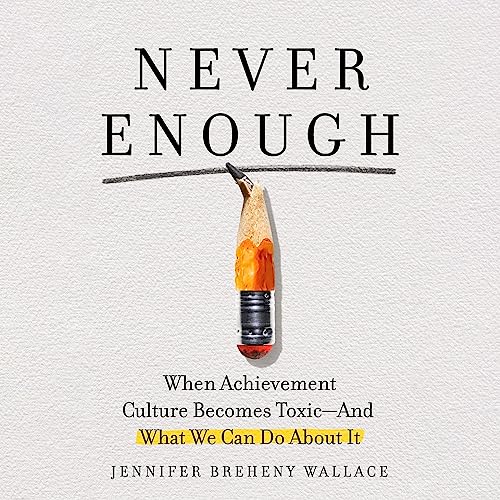
Never Enough
When Achievement Culture Becomes Toxic-and What We Can Do About It
Impossible d'ajouter les articles
Désolé, nous ne pouvons pas ajouter cet article car votre panier a atteint sa capacité maximale.
Impossible d'ajouter le titre au panier.
Veuillez réessayer plus tard
Impossible d'ajouter le titre à la liste d'envies.
Veuillez réessayer plus tard
«Retirer de la liste d'envies» a échoué.
Veuillez réessayer plus tard
Échec de « Suivre le podcast »
Échec de «Ne plus suivre le podcast»
0,99 €/mois pendant 3 mois + 15 € de crédit Audible
Renouvellement automatique à 6,99 €/mois après 3 mois. Annulation mensuelle possible.
L'offre prend fin le 28 décembre 2026.

Never Enough
Lu par :
Jennifer Breheny Wallace
Acheter pour 17,89 €
-
Lu par :
-
Jennifer Breheny Wallace
À propos de ce titre
The definitive book on the rise of “toxic achievement culture” overtaking our kids' and parents' lives, and a new framework for fighting back
In the ever more competitive race to secure the best possible future, today’s students face unprecedented pressure to succeed. They jam-pack their schedules with AP classes, fill every waking hour with resume-padding activities, and even sabotage relationships with friends to “get ahead.” Family incomes and schedules are stretched to the breaking point by tutoring fees and athletic schedules. Yet this drive to optimize performance has only resulted in skyrocketing rates of anxiety, depression, and even self-harm in America’s highest achieving schools. Parents, educators, and community leaders are facing the same quandary: how can we teach our kids to strive towards excellence without crushing them?
In Never Enough, award-winning reporter Jennifer Breheny Wallace investigates the deep roots of toxic achievement culture, and finds out what we must do to fight back. Drawing on interviews with families, educators, and an original survey of nearly 6,000 parents, she exposes how the pressure to perform is not a matter of parental choice but baked in to our larger society and spurred by increasing income inequality and dwindling opportunities. As a result, children are increasingly absorbing the message that they have no value outside of their accomplishments, a message that is reinforced by the media and greater culture at large.
Through deep research and interviews with today’s leading child psychologists, Wallace shows what kids need from the adults in the room is not more pressure, but to feel like they matter, and have intrinsic self-worth not contingent upon external achievements. Parents and educators who adopt the language and values of mattering help children see themselves as a valuable contributor to a larger community. And in an ironic twist, kids who receive consistent feedback that they matter no matter what are more likely to have the resilience, self-confidence, and psychological security to thrive.
Packed with memorable stories and offering a powerful toolkit for positive change, Never Enough offers an urgent, humane view of the crisis plaguing today’s teens and a practical framework for how to help.
Ces titres pourraient aussi vous intéresser



adbl_web_anon_alc_button_suppression_t1
Author ended up taking an easy way out - instead of digging into the roots of the problem, she simply confirmed her personal opinion on the topic, and gathered evidence to steel man it, ridiculing and undermining the opposite views.
Summary of her argument:
1. Happiness and wellbeing is not correlated with strong performance during study or with high achievement at work. We should optimise for happiness and wellbeing ("a balanced life", "everything in moderation"), so maximising focus on achievement is a wrong way.
2. Focus on performance and achievement makes some kids depressed, anxious, sometimes suicidal, so we should all slow down and reduce the pressure.
To me, both points are just ridiculous. And I can't understand why she did not dig past those.
Going for a balanced life, happiness and wellbeing is a personal choice. Author made it, but she presents it as an only right way. It's not. Some people choose achievement, and who are we to tell them they are wrong? If you want to be #1 in a super-competitive area (think CEO, olympian, etc.) - you will have to sacrifice big parts of a "balanced life" to get there. It's a choice you can make. If author doesn't have the ambition to make that choice, why ridicule those that do? She calls their motivation "keeping with the Joneses" and other diminishing ways ("toxic competition", etc.), that's absurd. It's their choice, they are free people and can make that.
The second argument is even worse. If some kids struggle, it doesn't mean we should all slow down. Here's a metaphor. If there is a sports team and most members can handle 10 hours of training, but few can handle only 6 hours. Should everyone do 6 hours or should those that can't handle 10 hours go to another team that trains 6 hours? If the whole team slows down, they will have worse results overall. Why advocate for this? If you can't handle the pressure, go to another company/school/etc. where the pressure is lower. Why drag everyone down to your level? The problem is not that the school or company has high pressure, it's that people who can't handle it are not realising their personal limitations and burn out there. So the answer is not to slow down, but to select the applicants better to only admit those who can handle the pressure - as some are able to. Then we can have both schools for top performers, schools for middle of the pack performers, etc.
Those are such obvious points that the fact that author just confirmed her own views and wrote the whole book around it, is crazy to me. She could instead actually find ways to evaluate who can handle how much pressure to better select school and work applicants, helping both companies and schools avoid depressed burned-out kids and workers. Instead this book is
simply promoting her own personal worldview.
Overall disappointed
Une erreur s'est produite. Veuillez réessayer dans quelques minutes.